
State of the art
In some ways, there are now three major cultural festivals planned for 2028 — and there will likely be even more
In some ways, there are now three major cultural festivals planned for 2028 — and there will likely be even more

You might not have noticed Burbank's new airport project flying under the radar because it went a lot faster than some other airport projects in the region
Hear from a Olympic and Paralympic expert on October 19 at noon on Zoom
In some ways, there are now three major cultural festivals planned for 2028 — and there will likely be even more

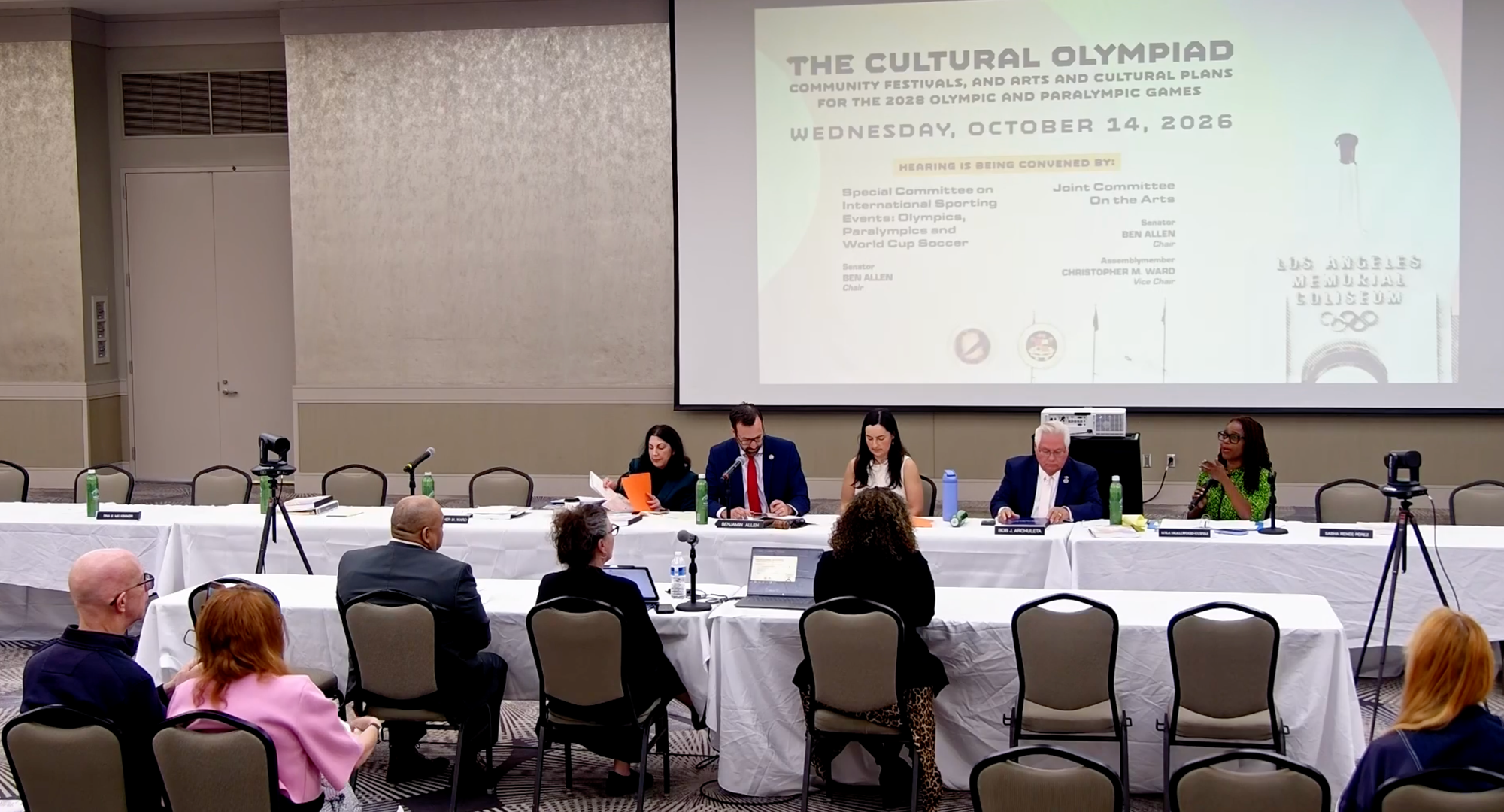
On a crisp fall Wednesday before the Santa Anas kicked up again — autumn isn't officially here until we have our first red flag warning — a dozen California legislators gathered in a ballroom at the California Science Center just feet away from shrieking elementary students queued up see the IMAX movie Antarctica 3D. I've covered these combination-Pizza Hut-and-Taco Bell meetings before, and this one was a mouthful — Special Committee On International Sporting Events and Joint Committee on the Arts — but this hearing was particularly notable as it might be considered to be the first comprehensive update on the Cultural Olympiad.
Only half of the electeds made it to the end of the four (!) hour meeting which tells you how much ground there was to cover. Planning for LA's Cultural Olympiad — the IOC-required arts festival that runs concurrent to the Olympics and Paralympics — is so woefully behind that agenda regular Zev Yaroslavsky had lamented at the last LA-based state hearing that there was no arts festival being planned for 2028. Not true; planning is underway. But his comments this week once again noted the extra-long lead time — 11 years total! — and compared the relative lack of concrete details from LA28 to the "catalytic" energy that already surrounded 1984's Cultural Olympiad at this point in the process. "It's nobody's fault who's sitting in this room," he said — okay, so whose fault is it? — "but time's passed us by."
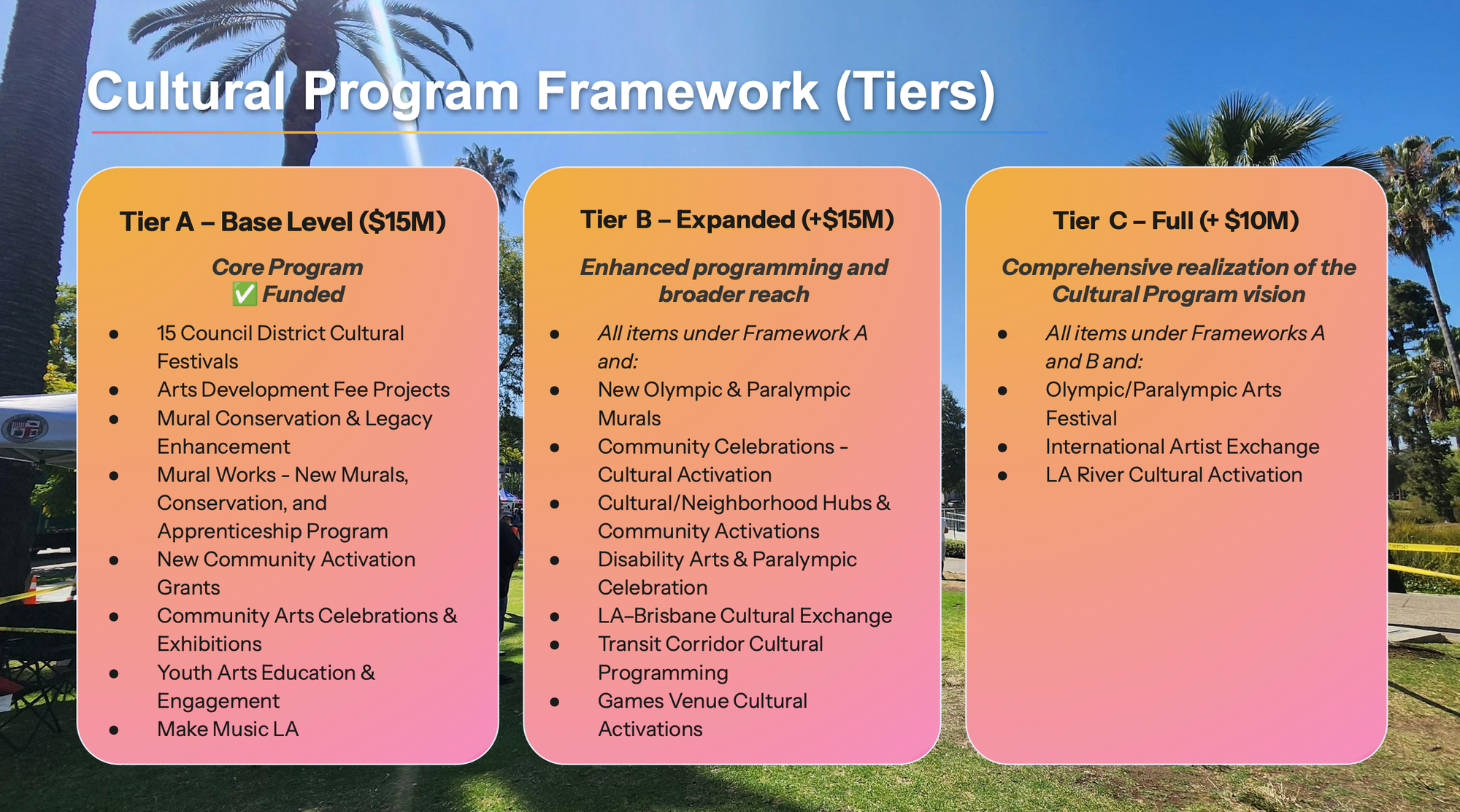
LA28 might be playing catch up, but thanks to the tenacity of LA's city and county arts departments, there are complementary city and county plans very much in motion for the summer of 2028, greatly informed by a series of regional listening sessions that started in 2020. (Watch my Torched Talks with LA Commons' Karen Mack, the master convener and community curator, to hear all about this process.) These have fully-formed strategic plans and even some dedicated funding.
So, in some ways, there are now three major cultural festivals planned for 2028, plus programs being planned in smaller cities like Santa Monica, West Hollywood, and Long Beach, which all appeared briefly at the hearing.
And there will likely be even more. The highlight of the hearing was Tawny Paul, director of the UCLA Luskin Center's Public History Initiative, sporting a sweatshirt her grandfather wore when he competed in sailing at the 1932 Olympics. Paul talked about the legacy of LA's 1984 Cultural Olympiad, named the Olympics Arts Festival, which was the largest art festival in the country in history at the time. It was also heavily criticized for being too Eurocentric, more about importing old-world artists to perform in the U.S. instead of promoting everything that LA had to offer. This led to the formation of various fringe festivals, some of which, like the Peter Sellars-helmed Los Angeles Festival, became their own 1984 legacies. I'm already hearing about similar fringe festivals in the works for 2028 from artists who would prefer not to be associated with the Casey Wasserman-Donald Trump of it all.
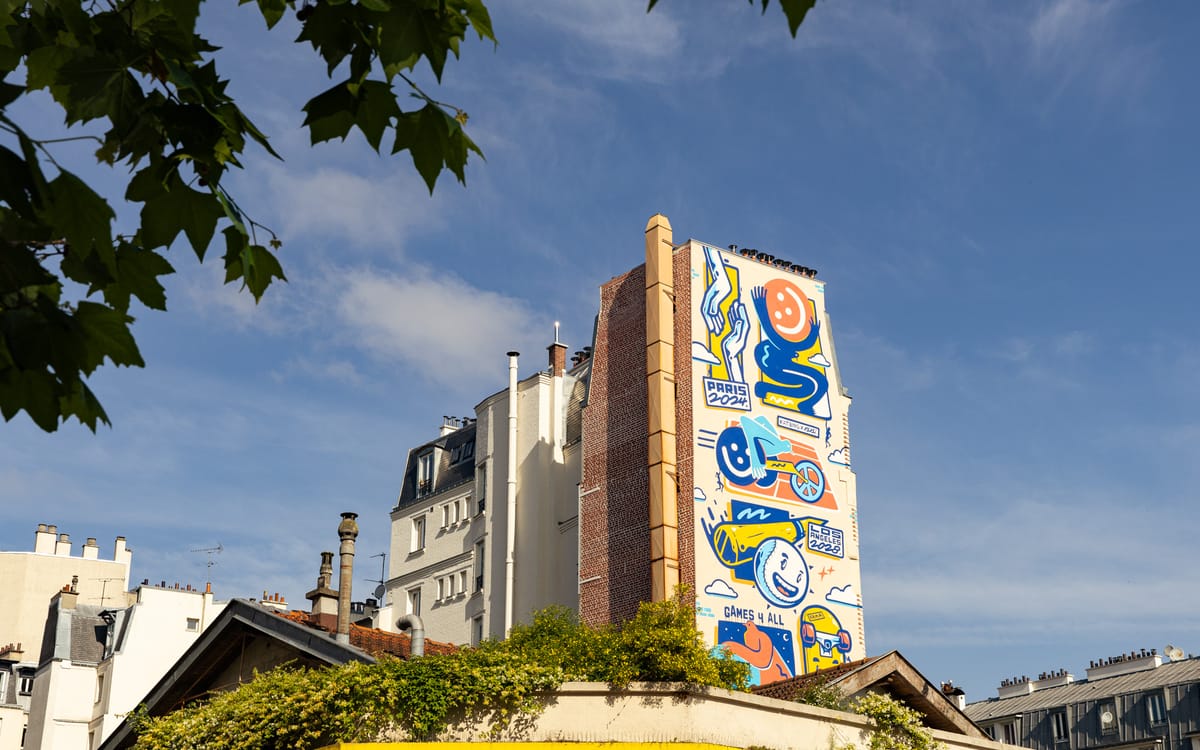
Paul and her team produced an astonishing set of resources with extensive historical perspective, policy recommendations, and comparisons to other host cities. (As I learned during my trip to Paris, the bar is high: cultural events began four years ahead of the games and included major legacy arts programs.) My favorite document is Paul's neighborhood toolkit which brings all the recommendations down to the hyperlocal level. Because the best examples from Paul's research were co-production models that collaborated closely with communities across many years. "Working through an existing cultural landscape that goes beyond large established institutions is what leads to success." What the Cultural Olympiad can do is lend visibility, but, as Paul cautioned, "visibility without resources will favor institutions and communities that already have capacity."
Paul's warning felt extra resonant as LA28 officials stepped up to the mic.
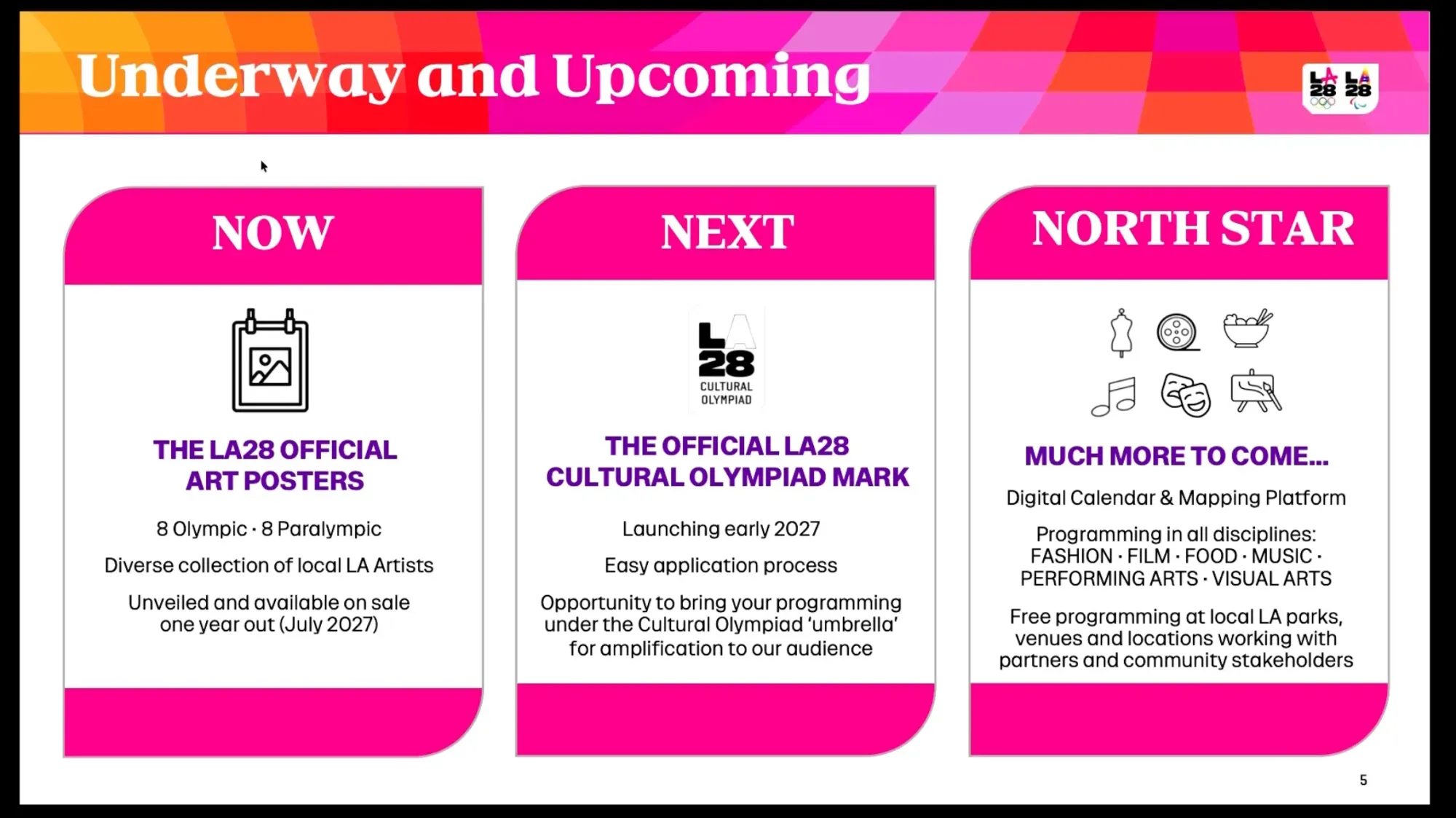
As I reported last week, with little time and uncertain funding, the 2028 Cultural Olympiad is almost exclusively focused on visibility: branding existing events, exhibitions, and festivals starting as early as January 2028 as part of the Cultural Olympiad. Institutions will apply starting in early 2027 for the "mark" that brings programs under the Cultural Olympiad umbrella. In turn, LA28 will promote these programs on a new digital platform with maps and schedules — I love a good megaevent calendar! — and offer subsidized tickets to events under a program named Culture for All.
This is where my ears perked up, as I hadn't heard details about this program before.
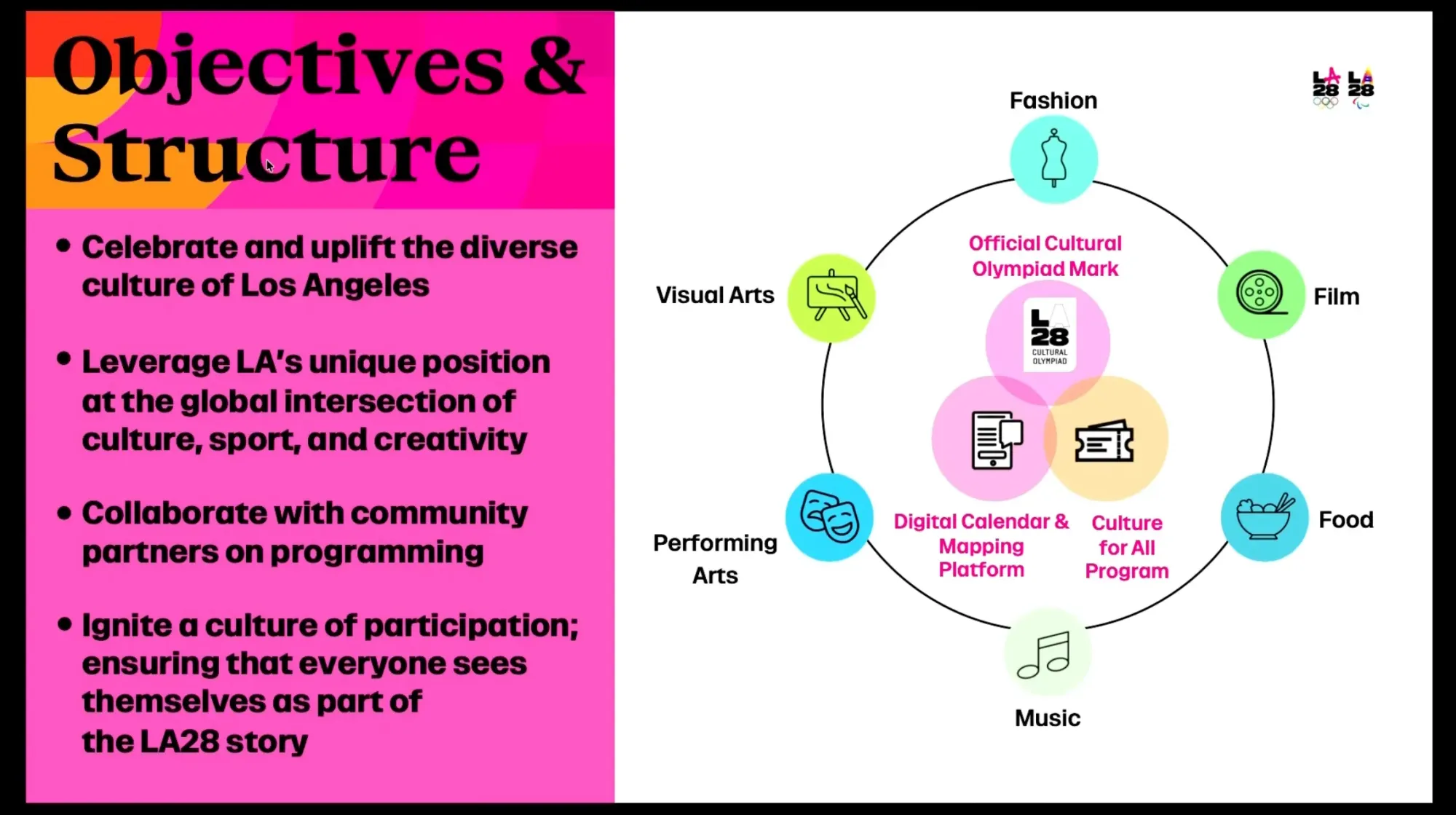
In May, LA28 put a Cultural Olympiad page on its website that describes "an underwriting program [that] will reduce or eliminate ticketing and entrance fees for some cultural programming... inclusive of park stages and film screenings." Here's how Dwayne Jones, VP of Cultural Olympiad & Stakeholder Events, described the Culture for All program at the hearing:
We will also have a Culture for All program, where we will provide funding to offset the costs for institutions, small nonprofit organizations, people who are already doing great programming, but have ticket prices that may prevent some people from experiencing that. We want to make culture more accessible to people and break down some of the financial barriers to access that, to be able to get tickets to an event, to some programming that's happening all across the region, but they may not have the financial means to do so. We want to open that up, but we don't want those institutions or organizations to lose money in being able to offer that lower ticket price. They need to be able to put their programming on.
My first thought was that there are so many LA cultural institutions that are already free, so how would this even work? But all arts organizations, even the well-endowed ones, are struggling right now, says art critic Carolina Miranda, who writes KCRW's Art Insider newsletter, and any help would be welcomed. Take, for example, the LA Opera, which is possibly the most significant legacy of the 1984 Cultural Olympiad. "For LA Opera, if it means they’re somehow able to engage new audiences, it would be a good thing for them," she told me. "Ideally, it would be low-income folks or people who haven’t been before. But how do you sort that? Other than if you have preexisting LA Opera account?" We worried this process would roll out like LA28's promise to offer $28 Olympics tickets to locals, which didn't materialize for most in a process with so little transparency that LA City Councilmember Katy Yaroslavsky — all these Yaroslavskys, always keeping it real — said she felt like the city had been "misled."
But subsidized ticket prices for the summer of 2028 are not what the institutions are asking for, at least according to the findings of those listening sessions with over 300 local arts representatives shared at the hearing by Arts for LA's Gustavo Herrera. In his presentation, he noted that 89 percent of respondents asked for multi-year unrestricted funding — "sustained investment, not a one-time surge." Many of the listening session participants are now working in other coalitions named Mosaic LA and LA Rising with the goals of creating community arts hubs and a cultural district network that last long after 2028.
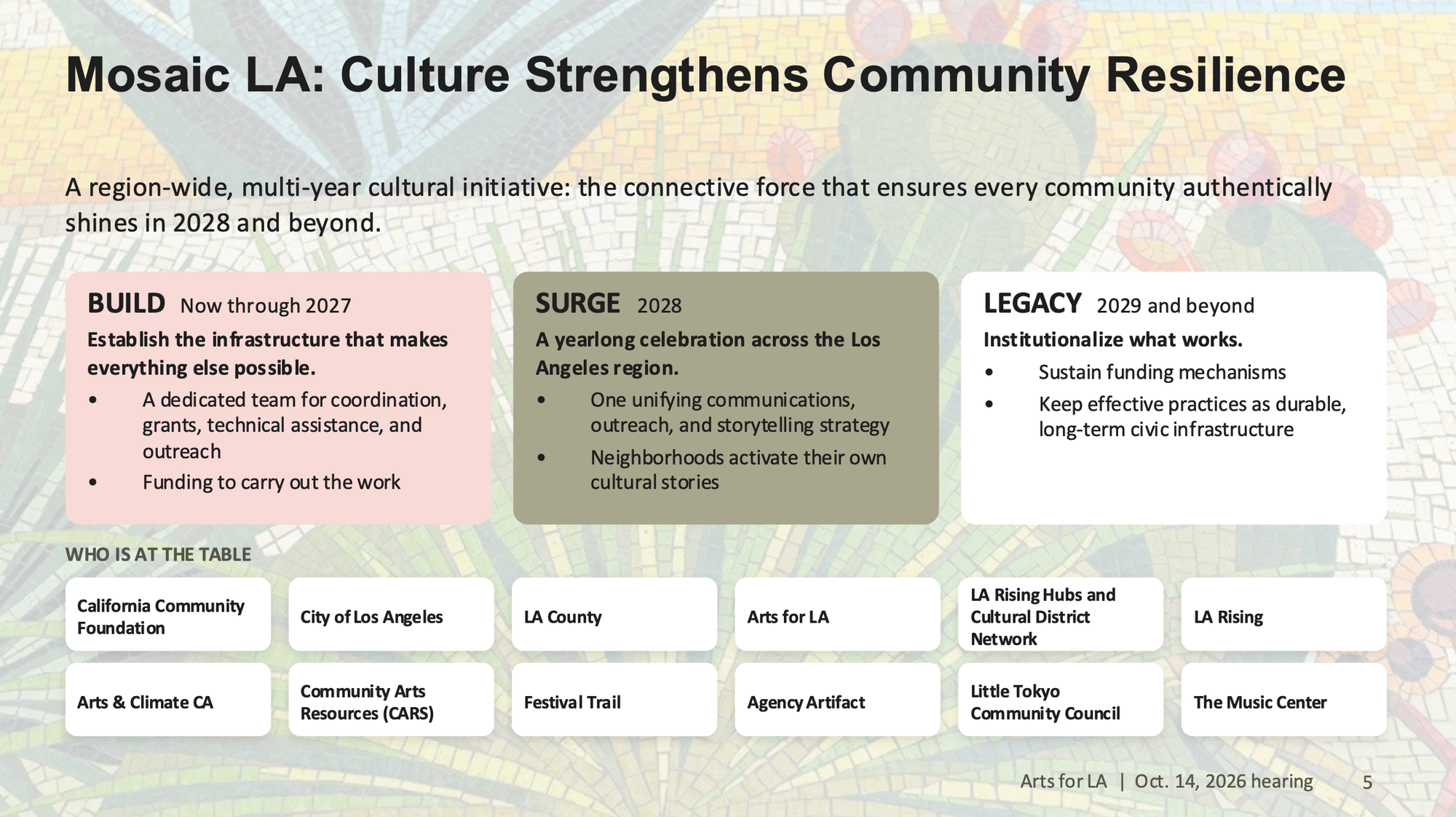
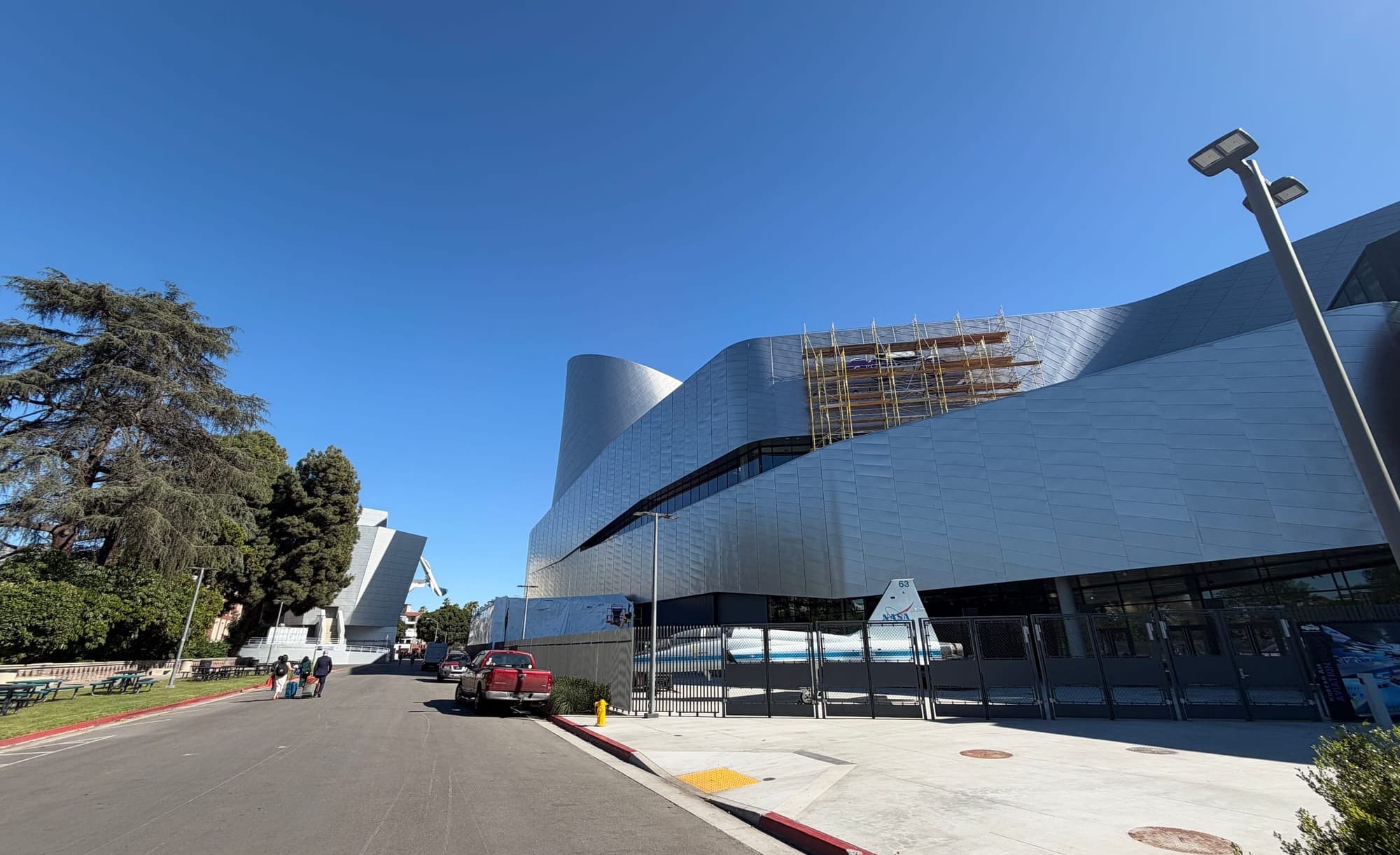
As I exited the hearing into the Rose Garden, I realized how significant it was for this hearing to take place in Expo Park, which is in the midst of a cultural capital plan renaissance. Scaffolding is almost down at the California Science Center, where a vertically reoriented Endeavour space shuttle opens to the public on November 13 (tickets go on sale October 21). In 1932, the Cultural Olympiad awarded medals in artistic categories at what is now the Natural History Museum, which opened its own massive expansion in 2024. LA28 appears to be soft-offering financial security for arts institutions for the summer of 2028, especially when international tourism trends are buoying concerns about attendance plummeting during the games, which happened in Paris, as Paul noted. (Might I recommend her report on museum continuity during megaevents!) But funneling corporate sponsorships to the institutions with the most expensive tickets seems like Paul's prophecy realized. Is LA28 going to underwrite tickets to make sure more people can go to George Lucas's museum for free? Besides, the Lucas (are we calling it the Lucas?) has its own program for subsidizing its $25 tickets, offering free admission to a single ZIP code.
And about those sponsorships. A New York Times story published one year ago amplified concerns from local arts leaders about the slow pace of fundraising, especially in our federal climate with local philanthropies stretched thin by LA's various ongoing crises. Jones said this week LA28 is working on raising "tens of millions" of dollars. But will that money trickle down to the cultural organizations that took the "if you want it, manifest it" advice to plan out their 2028 exhibitions on their own? Jia Yi Gu is the board vice president of the Feminist Center for Creative Work and has been working as an independent curator on an exhibition about the 1980s which would fit well into the Cultural Olympiad lineup. But she says she's been surprised how little effort there has been to bring institutions like hers into the fold. "Most of the conversation seems to be taking place in a top-down fashion, and primarily with some of the largest institutions in the city. No one has reached or even considered engaging with small- and mid-size local arts organizations under the one-million mark," she says. "Considering the economic weight of the Olympics, and the resources the city is devoting to the Games, I would expect cultural planners to anticipate how impactful a redistribution of these resources to cultural organizations would be as an opportunity to strengthen the arts and cultures in Los Angeles." LA28 is doing grantmaking for sustainability and human rights projects, why not the same for small arts organizations?
What LA28 is doing — offering light curation and few resources — is actually more like a fringe festival model, says Community Arts Resources' Aaron Paley, who approached LA28 in 2018 trying to get this conversation started, only to be told to come back in five years. But there are some resources coming, he noted. Groups like Mosaic LA and LA Rising have been engaging with LA philanthropies eager to get involved; those meetings are happening now. And while legacy is not necessarily spelled out explicitly in LA28's plans, that doesn't mean it won't happen. "The 1984 organizers never said they wanted a legacy — they just did it and there was lasting legacy," he told me. "It's good to be intentional about legacy but it’s not the only way that it happens."
But if bringing visibility to local art is key to LA28's commitment, that visibility needs to scale exponentially. The official start to the Cultural Olympiad is coming in just about a year. Unless you were here in 1984 or connected to the art world, it's unlikely you know LA is hosting what will be basically be a third megaevent in 2028. There was a small launch event at Disney Hall in May, but there was no special announcement of the Cultural Olympiad's plans made to the art press, the same way that, say, LA28's graphic identity was splashed across the design press. There's no dedicated tab under the Games Plan menu on the LA28 website. As I crunched through Expo Park's fallen sycamore leaves, I glanced over at the Coliseum and wondered when LA's artists and art institutions will get their moment to shine under the eternal flame — just like the athletes already do. 🔥


"There is nothing that we can propose to you that would eliminate that risk"

The official look and feel for the games shows, once again, that LA28 doesn't really understand our city

There is growing concern around the absence of a cohesive human trafficking prevention strategy for LA's megaevent era