
Here's what the Olympics will actually do to your commute
Almost certainly make it better

In the summer of 2028, 369 miles of dedicated lanes known as the Games Route Network will be restricted to certain vehicles for the Olympic and Paralympic Games. This is not new information. The maps and signage have been shown at public meetings and available in public documents for years. (I wrote about the Games Route Network in 2024, the "bluebell" signs in April, and the plan for automated enforcement in August, similar to what we already use for our bus-only lanes.) But all you have to do is insinuate that a sliver of Southern California roadway might someday not be unavailable to drivers in the near future, and you get a headline like this one in the Los Angeles Times: "LA freeways, roads to be closed to general traffic for 2028 Olympics. How will it hit your commute?"
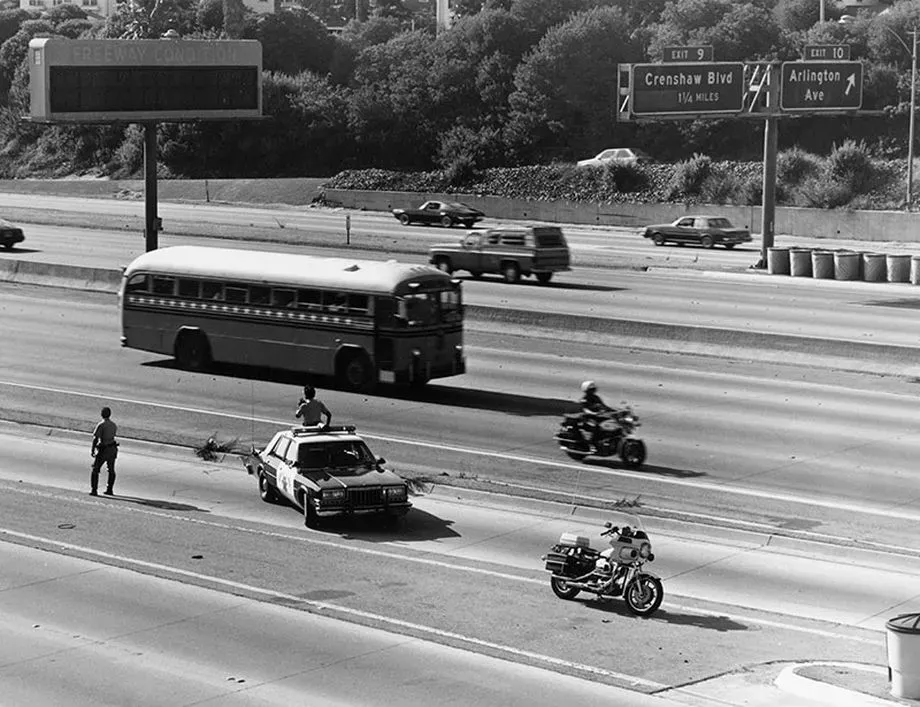
Many other outlets reacted the same way — the very same publications, I might add, that also claim air taxis will simply sail above any LA28 traffic! I know can't fault the social media managers, or even the headline writers. But I have to pick on the LA Times because the newspaper published the definitive story — "A Rocky Road for Transit Planners: How to Ease the Gridlock? ’84 Olympic Experience Provides Elusive Model" — on how great a similar approach to LA's 1984 Olympics was for, yes, effectively eliminating traffic. And, more importantly, what happened when we let all those good changes lapse:
It was a magic time. For 16 days in the summer of 1984, driving to work seemed almost a joy--and then the XXIII Olympiad came to an end, officially closed by Los Angeles Mayor Tom Bradley with a prophetic quip: “The Games are over, let the traffic begin.”
The next day the freeways were congested, the rutted surface streets bumpy and crowded as ever. Five years later, the congestion has only grown worse, and politicians, traffic experts and commuters can only look back longingly on the Olympic traffic-management plans and wonder why those same, relatively simple tactics cannot be resurrected.
In 2018, I wrote my own version of this story for Curbed LA (RIP Curbed LA) where I talked to ten experts about how we could start getting the planning in place for 2028 so these improvements didn't evaporate. 2018 me thought the city would get right to work. Silly 2018 me.
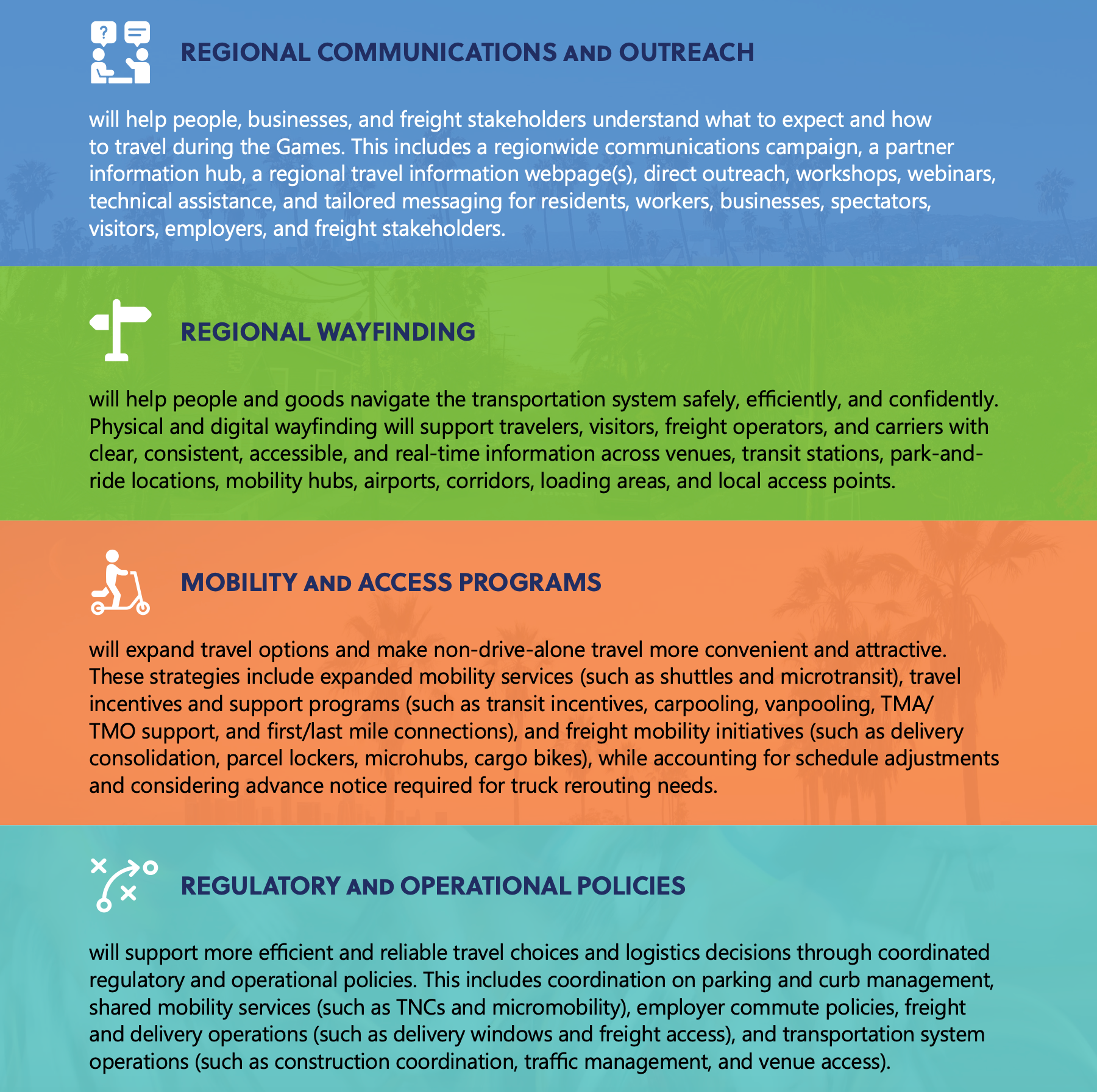
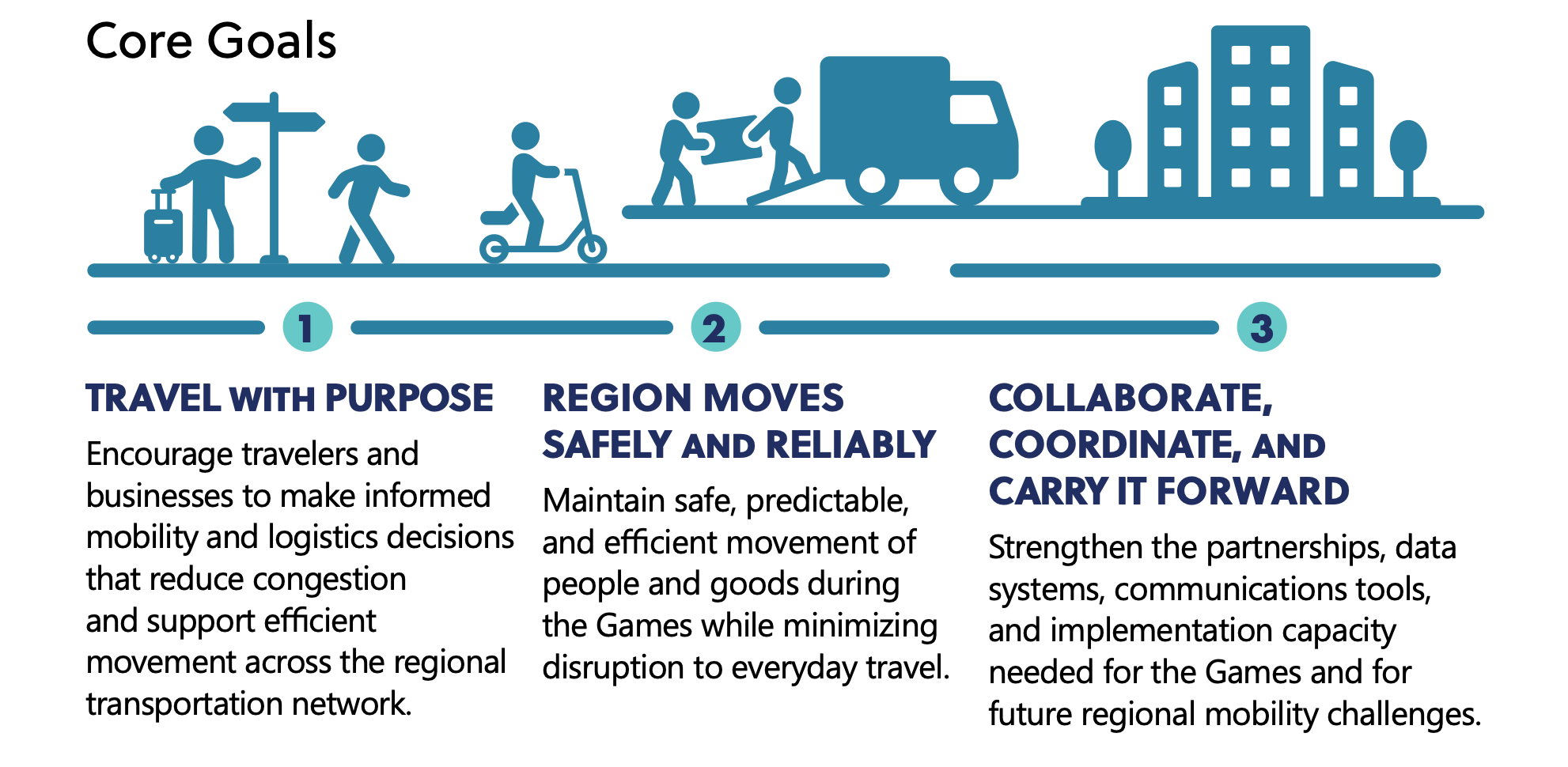
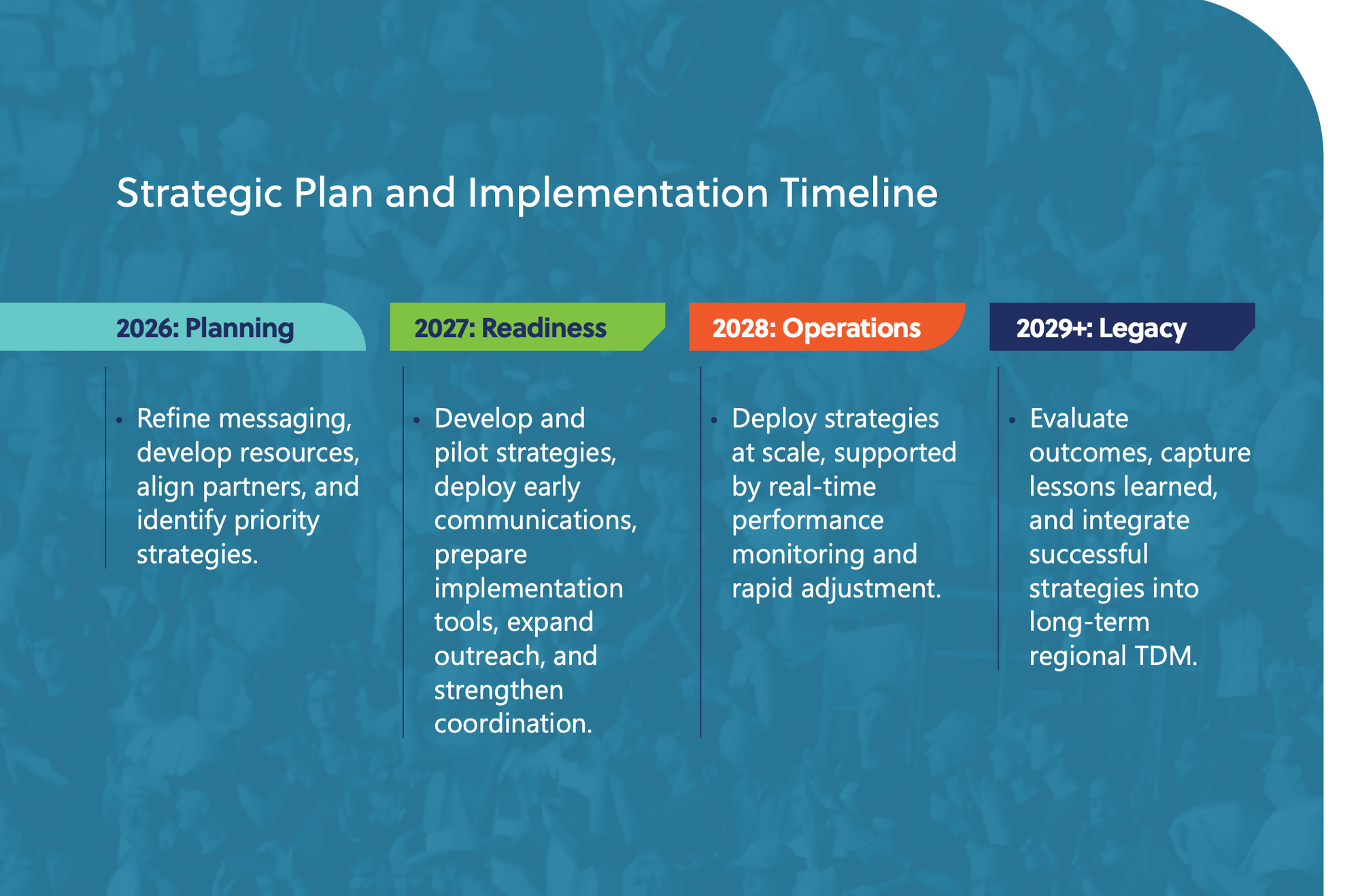
Eight more years and a pandemic later, LA has a very different relationship with traffic, commuting, and incentivizing behavioral change. Just like the fleeting promise of the "car-free" games (RIP "car-free" games) these fear-mongery headlines are the result of our leaders neglecting to get out in front of the messaging. But the Southern California Association of Governments, fondly known as SCAG, has been quietly working on a strategic plan for 2028 for a few years. Luckily, when I went to speak at SCAG's Regional Council meeting earlier this month, I got a literal front-row seat. Torched is happy to offer you an exclusive look inside the 2028 Games Regional Transportation Demand Management Strategic Plan, the plan to move athletes, officials, spectators, goods, and Angelenos who want to avoid the Olympics at all costs.
The truth: this won't ruin your commute, it will almost certainly make it better.
When I asked SCAG's executive director Kome Ajise what he wanted regular Angelenos freaking out about traffic to know about the goals of the plan, his answer put those regular Angelenos first. "To make sure that folks can get to all their activities and also that the athletes and the officials and all the people involved in the games can do what they need to do," he says. But there's a second part that differs greatly from 1984, says Ajise: "We want to change our mobility stance after the games are done."
That's a tall order. It's also not something, Ajise notes, that you can easily communicate in a sound bite. But let's try.
Here's how the strategic plan sums up the challenge, which is really the first time I've seen it articulated so well:
The 2028 Games will present an unprecedented transportation and goods movement challenge as events will span more than 40 venues in Southern California, covering multiple counties, jurisdictions, and transportation systems. Events will take place simultaneously across multiple venues each day, as will many fan fests, public viewing opportunities, and hospitality houses. Some locations will experience heightened venue activity, temporary roadway changes, and increased transit demand, while others may see more limited but still meaningful shifts in travel patterns, business operations, and freight movement.
On peak days more than 600,000 spectators will travel throughout the region — roughly equivalent to hosting eight FIFA World Cup matches on a single day. Venue zone projections vary widely ranging from an estimated 2,400 daily spectators and workforce at the Whittier Narrows Clay Shooting Center to more than 135,000 at the Exposition Park Zone. Ticket sales data will be invaluable in understanding the breakdown of local, regional, and non-local spectators and will provide valuable insights into where spectators are coming from, both within the region and outside the state or country.
Okay, so forget, for a minute, about lanes. What we're really talking about is a very small part of what's called a transportation demand management, or TDM, plan. And it's likely you've already experienced very effective TDM plans. The best possible example being the extremely successful system at the Hollywood Bowl, where a combination of 19 shuttle routes plus practices like bundling transit with ticket sales really gets people out of their cars. Last season, 41 percent of the audience got there without one.
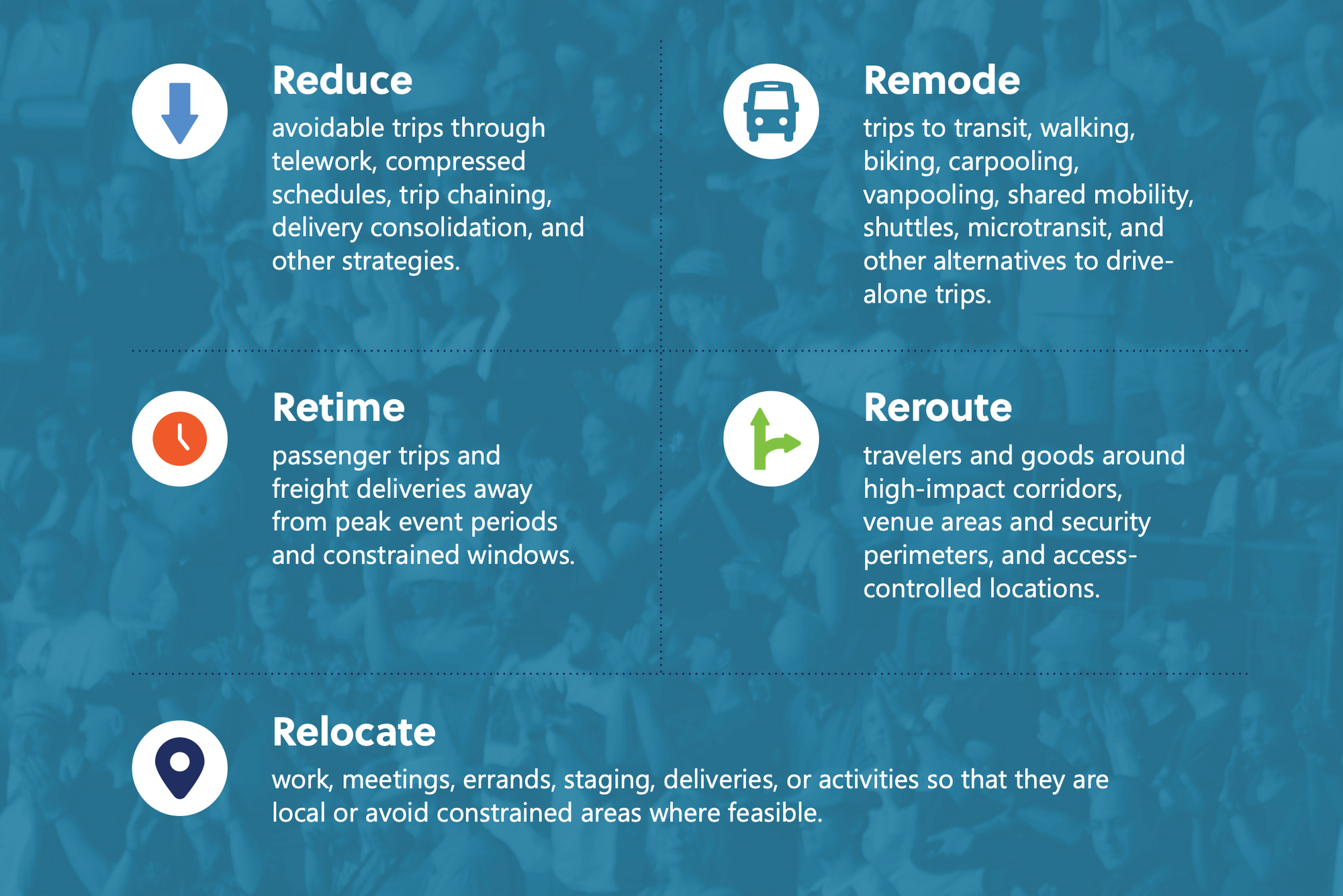
Some TDM techniques were deployed during the World Cup: the freeway signs, the direct buses to SoFi, and parking priced as high as $65 at major hubs like Union Station, which I can say first-hand really works; as someone who stood with the team surveying shuttle riders, virtually everyone said hell no, they did not park, they took the train to Union Station. And according to a recent Metro report on World Cup operations, baseline service was not interrupted — although there were definitely some detours around SoFi — with only 2 percent of all bus and train runs canceled during the entire 39-day period.
We've also had good practice doing this as a city. Remember the "traffic nightmare" of 2024 or the "sports equinox" of 2018? Or how local leaders rallied to boost transportation options after the 10 freeway fire in 2023? Or Carmageddon, the gridlock that didn't happen during the 405 closure in 2011? That's when LA28's VP of transportation Sam Morrissey was working as the parking and traffic manager at the city of Santa Monica. And he's drawn upon that experience in particular to frame the summer of 2028 in a slightly differently way. "We are a transit-first games. That does not mean that the games are the only thing using transit," he says. "We are putting transit first, which also means the existing public transit ridership." I feel like Morrissey is saying something I'm not hearing enough. It's not just "transit-first" games — although I still prefer "car-free" — it's really about working together as a transit-first region. NO MORE SCARE QUOTES.
But part of that will mean asking some people to temporarily shift their mobility patterns for a month or so. And that is one legacy we can claim from 1984, says Morrissey. In the lead up to our last Olympics, Commuter Computer, an influential organization established during the 1970's energy crisis, led the campaign for 1984 encouraging workers to form carpools, switch to transit, shift schedules, or yes, just stay home. After the Olympics, the state passed Rule 2202 as part of an emissions-reduction strategy requiring every California company with over 250 employees to draw up similar TDM plans. (Whether or not they're implementing these plans is another story.) But theoretically, thanks to Commuter Computer's groundwork, every major employer has plans which can be activated. Morrissey lays out how this might work. "If you have an office complex near Exposition Park, we are going to have to do targeted messaging," he says. "Look, the 100-meter-dash finals is on this day. It is the busiest event. We're not telling you to stay home. We're not telling you to not go to work. But please know that there will be tens of thousands of people at this time in this region. You might want to look at adjusting your schedule."
Morrissey also thinks this messaging could be fun, in the same way the 1984 organizers tapped celebrities to do PSAs. "Every time I cross paths with somebody from NBC, I tell them I want to resurrect the Californians sketch from SNL," he says. "I think it would resonate." (NBC being a global IOC sponsor, of course.) My question is: does that messaging effectively reach the street vendors, day laborers, unhoused neighbors, and regular transit users?
But let's stick with Expo Park as an example of what else will change in 2028. Even though we've heard officials walk back the "car-free" promise, there will absolutely not be any parking at many major venues. This area is obviously well-served by the E Line. But on the western edge, Vermont will be a bus corridor — like it was temporarily in 1984; this time will be Metro's permanent bus rapid transit project that I really hope will be done by 2028 — and, on the eastern edge, Figueroa will be an open street for the entirety of the games. A CicLAvia that lasts, essentially, for much of the summer. This is more about keeping vehicles out of the security perimeters, says Morrissey, but it does present a chance to pivot more firmly towards that transit-first region. "I do wish that more cities would embrace these perimeters as a way to enhance in-street activities and multimodal transportation," he says. "We have this tremendous opportunity to show people what it can be like without streets clogged with cars."
Goods need to be moved in and out of those security perimeters, too — those Michelob Ultra beer gardens aren't going to stock themselves — as well as flow seamlessly throughout the entire region. Which is why SCAG launched a separate Goods Movement Forum to shape those recommendations. These types of conversations were a key part of 1984, when many deliveries shifted to overnight hours, which consequently removed a lot of peak-hour traffic from roadways as well. In addition to reviving those strategies, there's also an idea to potentially shift the ports to overnight hours. "Those conversations are happening between the ports, the marine terminal operators, and, of course, the unions," says Ajise. "If we do that, where are the goods going to be delivered? Are those warehouses going to be open at the same time?" This would also require a review of how any change in operations impacts the communities around the ports and warehouses.
Many of the goods-movement adjustments you likely won't notice, but what you will see are so many more small delivery vehicles, says Morrissey. Not even LA28 knows the exact security perimeters for sure yet, he says, but by limiting car traffic, those cordons will end up demarcating their own clean-air delivery zones around every venue. "We may not know the specifics, but let's talk about the opportunities and get that in place, so when the specifics are known, we're ready to move with it," he says. Meanwhile I'll be over here dreaming about all those cutie cargo bikes and zippy golf carts scooting around instead of big trucks.
Fast forward to July 14, 2028. We'll know the plan is working when background traffic is reduced by 15 percent — that means every LA County resident is reducing their daily travel by three to four vehicle miles traveled. We should be doing that anyway for a whole range of climate, public health, and societal reasons, but the two weeks of the Olympics — followed by a two-week break, and then another two weeks of the Paralympics — is actually the perfect window for a test run. "The length of time allows us to hopefully build some habit-forming opportunities there," says Ajise. "The region-wide campaign will help our residents, our businesses, and our stakeholders understand what choices they can make. So instead of driving, could you take a bus, could you walk, could you bike? And if you have to absolutely take the trip and you decide on a mode, or you're still using the same mode, could it be at a different time?"
For Morrissey, showcasing choices is the opportunity: "I hope the legacy of the 2028 games is that we stop just talking about traffic, traffic, traffic all the time — and start talking about multimodal options."
Of course, there's a potential plot twist. (Cue the saxophones getting louder.) As I wrote earlier this month, federal funding has not yet come through for many of the options meant to alleviate the pressure on that background traffic. At that SCAG panel earlier this month, Metro CEO Stephanie Wiggins said LA28, which is already planning to pay for transit service for athletes and officials, might be on their own for providing transit service for spectators as well. I'm seated right next to her and you can see my reaction at the end.
Listen carefully to what Metro CEO Stephanie Wiggins said at this SCAG panel earlier this month about buses for 2028. "If we find ourselves where we're not getting the federal funding we need... LA28 will have to find some other delivery partner for it, because we can't undermine everyday service"
— Alissa Walker (@awalkerinla.bsky.social) September 16, 2026 at 8:35 AM
[image or embed]
These concerns were reiterated at a recent Metro board meeting. And we still don't have a clear understanding of LA28's budget, which was just casually raised to $7.263 billion without any line-item detail.
But not only can we do this, we already did it in 1984 without trains; as I say all the time, we were between rail systems at the time. (Behold, the entire park-and-ride system from 1984.) And the biggest myth about the 1984 games is that the only reason there was no traffic is because people left town. In fact, as I tried to emphasize in my 2018 Curbed story, by the end of the Olympics more people were actually moving around Southern California's roads, but because the volume of vehicles was more spread out and didn't form peak-hour travel humps, it still didn't feel like there was any traffic.
However.
Even the reports at the time noted that background traffic started to return once people saw the empty roads. This is a pretty common phenomenon, says Yu Hong Hwang, a research data analyst at UCLA's Institute of Transportation Studies. "The traffic starts coming back once people see it's free and clear," he says. "They think, well I can get out there."
Hwang, who was the co-author of an influential report on how to actually end LA's traffic — published just after we all witnessed the empty roads of early 2020 — says the pandemic also introduced new challenges. LA's traffic already doesn't peak at 5 p.m. anymore, the congestion is more spread out throughout the afternoon. Transit ridership also remains below pre-pandemic numbers, despite Metro's 28 by 28 initiative to accelerate major transportation projects. "Fast, frequent, and reliable transit gets people out of their cars," says Hwang. "That was the whole point of 28 by 28 — to have a more robust network."
As far as changing behavior, some of it is in the messaging, he says. "But I don't know how much SCAG has the power to make individuals change their response." The only real way to reduce traffic is congestion pricing, like the popular New York City program that recently celebrated one year of delivering astonishingly positive outcomes — faster buses! safer streets! less honking! — and $550 million for transit improvements. We already do a version of congestion pricing here in LA with our FasTrak program on freeways.
Which I guess brings it all back to the lanes. Once we've dedicated these 369 miles of lanes for this experiment, why not keep it that way for the good of the region? This is exactly what I was hoping to convey at the end of the SCAG meeting when I suggested we might use the Games Route Network to introduce congestion pricing — at least three people were applauding!
Again, the time for consensus building was ten years ago. But let's see what we can get accomplished in less than two. 🔥
🔠 Another really good reason to read the entire report: the glossary, which will help you understand what the hell people are talking about when they start spitting out acronyms like GETS (Games Enhanced Transit Service)
🚦 For fun, read the full analysis of 1984's TDM strategies, plus recommendations endorsed by SCAG in a cheery 1986 report entitled "The Olympic Legacy: Let's Keep it Moving"

Read next

The era of inherent risk
"There is nothing that we can propose to you that would eliminate that risk"

The Torched guide to LA's World Cup
A mission statement, a calendar of events, and an invitation to help shine a light on LA's public spaces, public transit, and public benefits


Cool streets
Paris's school streets are effectively sculpting out instant parks in the locations where they'll provide immense public health benefits to the city's most vulnerable populations