
The era of inherent risk
"There is nothing that we can propose to you that would eliminate that risk"

The honesty was refreshing. "We are, in some ways, confined to prior agreements that were made as a condition of agreeing to host the games that include inherent risk," Matt Szabo, Los Angeles's City Administrative Officer, said solemnly to the city council. "So I need to say that on the front end."
The back end was no better than the front end. "Of all the scenarios where there is inherent risk, the worst is for us to write a check to close a deficit at the end of the games," said Szabo. "If it is not financially successful, it does fall to us. There is nothing that we can propose to you — today, or tomorrow, or next year — that would eliminate that risk."
I'd waited ten months for this moment. Last week, LA's City Council finally took up the very delinquent Enhanced City Resources Master Agreement, originally due October 1, 2025, that determines what city services LA28 is paying for in the summer of 2028. I've written at length about the red flags raised both inside and outside LA's city government about this agreement, including an entire report of recommendations for what the city could do to put us in a slightly less precarious situation.
But, in so many ways, as Szabo and Chief Legislative Analyst Sharon Tso noted repeatedly in their presentations, LA's fate was already determined — in 2017 when the council voted to host the games, and then again in 2021 when the council approved the original games agreement.
The draft ECRMA agreement had been advanced from committee to the full council with no recommendation, so I assumed we were in for a lengthy debate. But most councilmembers didn't say a thing. The most penetrating inquiry came from Councilmember Eunisses Hernandez, who questioned Szabo and Tso and Deputy City Attorney Dan Kreinbring, whose department has been refreshingly honest about this agreement as well. At one point, seen at the end of this video, all three of them are almost chuckling at the ridiculousness of it all as Hernandez's questions reveal the only real recourse that we have as a city at this point is to sue LA28 after the fact — and hopefully before the organization doesn't dissolve.
Despite the dire warnings of inherent risk, 10 city councilmembers voted yes to advance this agreement. Only four councilmembers — Hernandez, Ysabel Jurado, Nithya Raman, and Monica Rodriguez — voted no. Raman — who issued a statement through her mayoral campaign condemning the vote — is the only sitting councilmember who also voted no in 2021. And it was especially frustrating to see some her fellow budget hawks who had refused to approve more parks funding or a city-bankrupting convention center, but voted yes for what might be the biggest financial calamity the city has ever taken on. Ever the accountant, City Controller Kenneth Mejia, who also condemned the vote — he's pushing for more auditing, and even internal audits would be helpful; something I've been asking for is tracking staff time spent on games-related work — brought the receipts, tracking all the councilmember votes since 2017. But it doesn't matter now. What little leverage we had has evaporated.
I've been thinking a lot about a better way to explain the city's responsibilities when it comes to potentially writing that check to close a deficit, and Szabo did it well during the meeting. Putting aside the state's promise of a $270 million backstop — which the state hasn't actually signed off on yet, whoops! — the city isn't really trouble until LA28 falls $600 million short of its own $7.1 budget, thanks, in part, to LA28's own $330 million "contingency fund" that's supposedly built in. But literally all of these numbers are made up. When LA28 claims their budget is over $7 billion yet cannot provide any specific details about hard costs, why should we believe this fund exists? Is Casey Wasserman using the funds from the sale of his talent agency or putting up his still-unsold Bird Streets estate as collateral? A few new financial guardrails have been introduced through this process, but what the city needs is total fiscal transparency. Open the books!
It felt extra wild to put our unconditional trust in LA28 against the headlines of the week. While this very conversation was happening in council, LA28's second ticket drop was live. Councilmembers had repeatedly asked LA28 officials for more transparency around what will easily be the most expensive Olympics in history to attend. LA28 won't say how many of the promised $28 tickets for locals are left and Angelenos who gained access to the second drop found slim pickings and astronomical prices. LA's leaders were promised affordable tickets by LA28, said Councilmember Katy Yaroslavsky after the first drop. "I feel like we were misled."
Then there's the fact that Council President Marqueece Harris-Dawson had to file yet another motion — on the same day that the agreement passed! — attempting to ensure that more procurement contracts will go to LA city businesses, not the five-county definition of "LA" that LA28 is proposing. "There is no assurance that Olympic-related spending will meaningfully benefit Los Angeles businesses, workers, and communities in proportion to the City's role as host," the motion reads. Would that motion — his second motion on the topic, actually — really be necessary if we thought LA28 would do what's right for the city of LA?
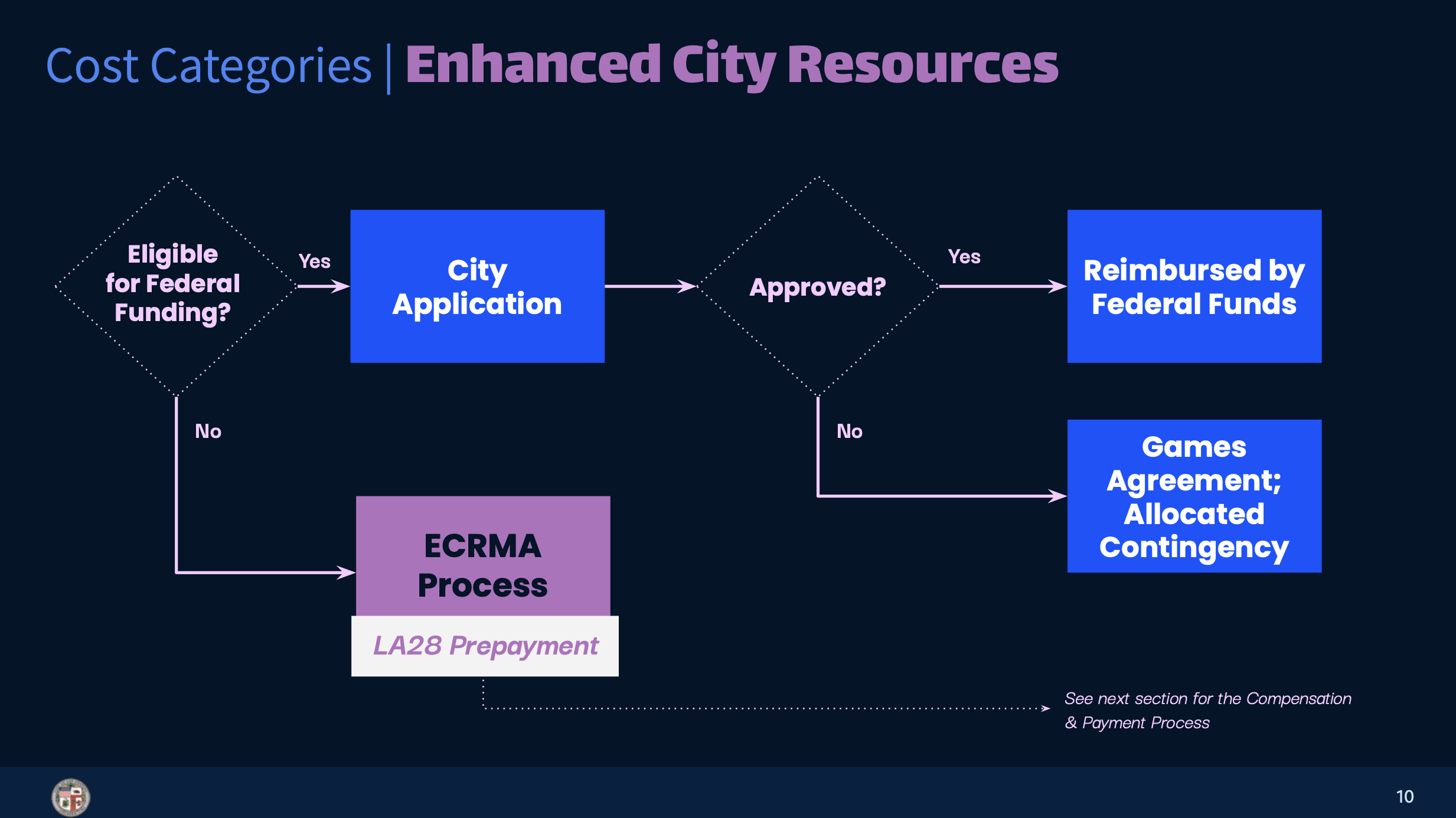
But the very biggest concern is the assumption that the federal government will reimburse us, particularly for so-called security costs. Each time local officials return from their gilded Oval Office sojourns empty-handed — no matter how many torches we bring along with us — it becomes more and more apparent that even with Trump's besties on board we are maybe not winning over this administration! So even if this was, hypothetically, a perfect agreement with LA28, which it is not, there is no guarantee the federal government is going to hold up its end of the bargain.
Even LA28 can't guarantee a good working relationship with Trump. At the same ad hoc committee meeting where the members advanced the draft agreement to the full council, I watched in shock as LA28 CEO Reynold Hoover, the folksy former Army general, lost his cool on the council floor. Councilmember Hugo Soto-Martínez had simply asked him for an update on LA28's potential collaborations with federal agents, including ICE. (We talked about this more on LA Podcast, and I highly recommend listening to the back and forth. It's spicy!) "Look, I don't know what ICE is going to do or not do in 2028, on the 14th of July, or before when the games come," Hoover snapped. "That's not my job."
Oh, it's not? I was recently reminded of LA28's shifting mission statement, which is captured annually by the IRS in its 990 statements. I'd always cackled a little when imagining LA28 officials earnestly believing their work could "improve & enhance the quality of life" of Angelenos.
But at the end of 2024, LA28's mission statement had changed, and pretty dramatically:
One major criticism of LA28 I hear a lot is that this LA nonprofit doesn't seem to be prioritizing the people of LA. Now we have proof, thanks to this quite notable shift in LA28's mission statement, as shown on its 990s from 2023 to 2024. Hmmm, I wonder what could have happened that year?
— Alissa Walker (@awalkerinla.bsky.social) August 13, 2026 at 4:10 PM
[image or embed]
As if we needed further confirmation that these games won't be for us. And maybe they never were. 🔥
🔗 And as summer ends, get ready for a retooled Hot Links! My weekly news roundup will be back and better than ever, thanks to all your feedback. And if you still have ideas for what you'd like to see right here on Torched, simply reply to this email. Remember: upgrade to paid, get early access to Hot Links, and get on the list for the paid subscriber party!
More essential reads
 Alissa Walker
 Alissa Walker

Read next


LA is not a bloomin' desert
The official look and feel for the games shows, once again, that LA28 doesn't really understand our city

"You can see how the sports events coming up are definitely a risk"
There is growing concern around the absence of a cohesive human trafficking prevention strategy for LA's megaevent era
