
Torched Talks with Keep the Flame Alive's Jill Jaracz
Hear from a Olympic and Paralympic expert on October 19 at noon on Zoom
Hear from a Olympic and Paralympic expert on October 19 at noon on Zoom


The week began with yet another deadline that LA28 did not meet. By September 28, LA City Controller Kenneth Mejia had demanded key financial information from the organizing committee, over which the city had recently admitted it doesn't have any operational control. Mejia's office had estimated hosting the 2028 Olympic and Paralympic Games has already cost the city at least $27 million, a number that seems laughably low when you consider how many municipal employees have been working on them for at least a decade. And then the laughter turns to deep, guttural sobs as you realize we don't know how much the games have cost LA28, either.
According to the games agreement made with the host city of LA, LA28's annual report — also delivered late, or at least made public late, just like the human rights strategy — is supposed to include a list of all contracts valued at $1 million or more. But as a Los Angeles Times report detailed on Monday, accounting practices had changed, and contracts were now listed without vendor name or dollar amounts — right as LA28's budget was casually revised up from $7.149 to $7.263 billion.
Here's the list of contracts over $1 million from the most recent annual report:
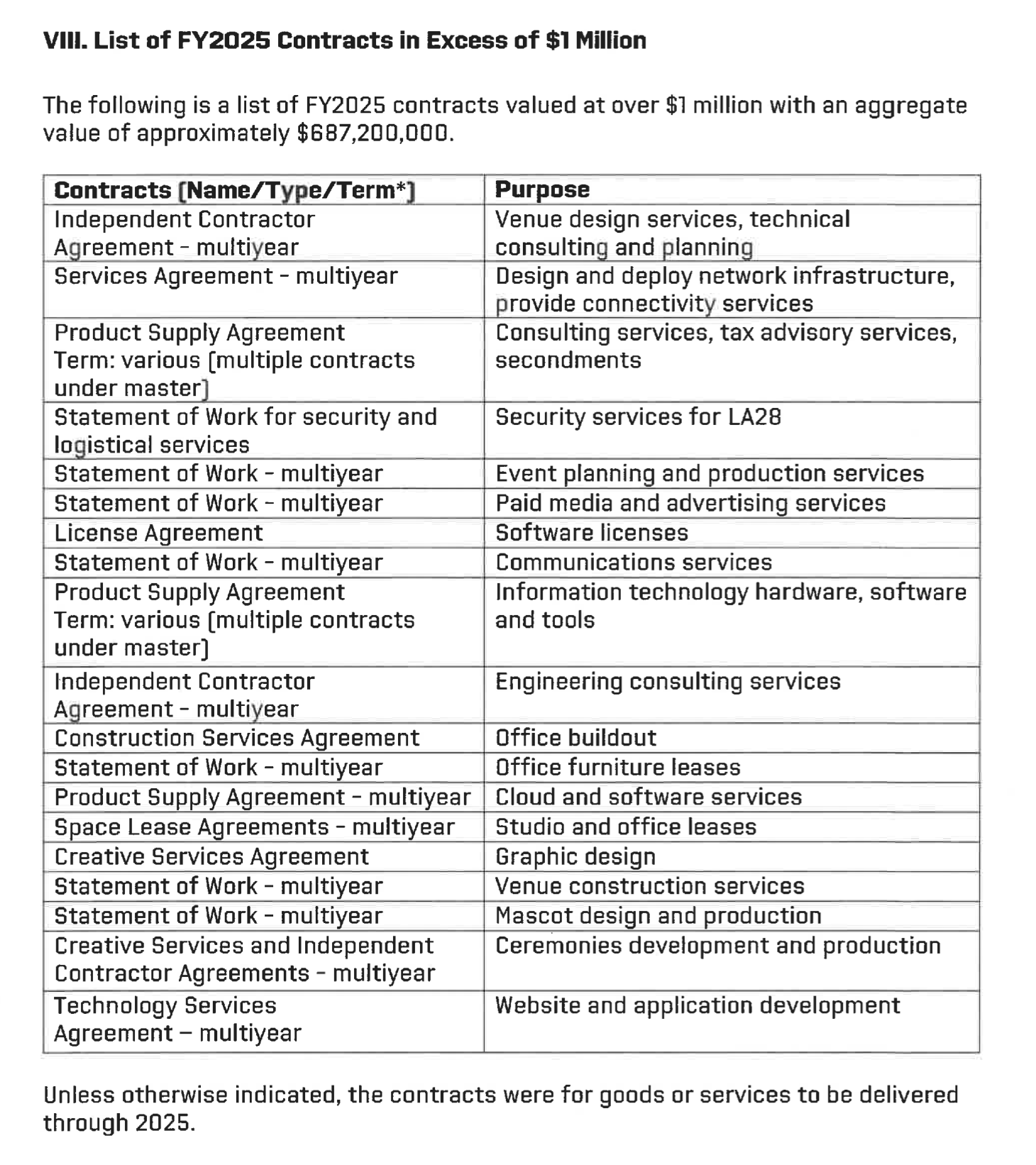
Pretty vague, right? Here's what it looked like when LA28 used to include that information. This is fiscal year 2023, for the annual report filed June 20, 2024:
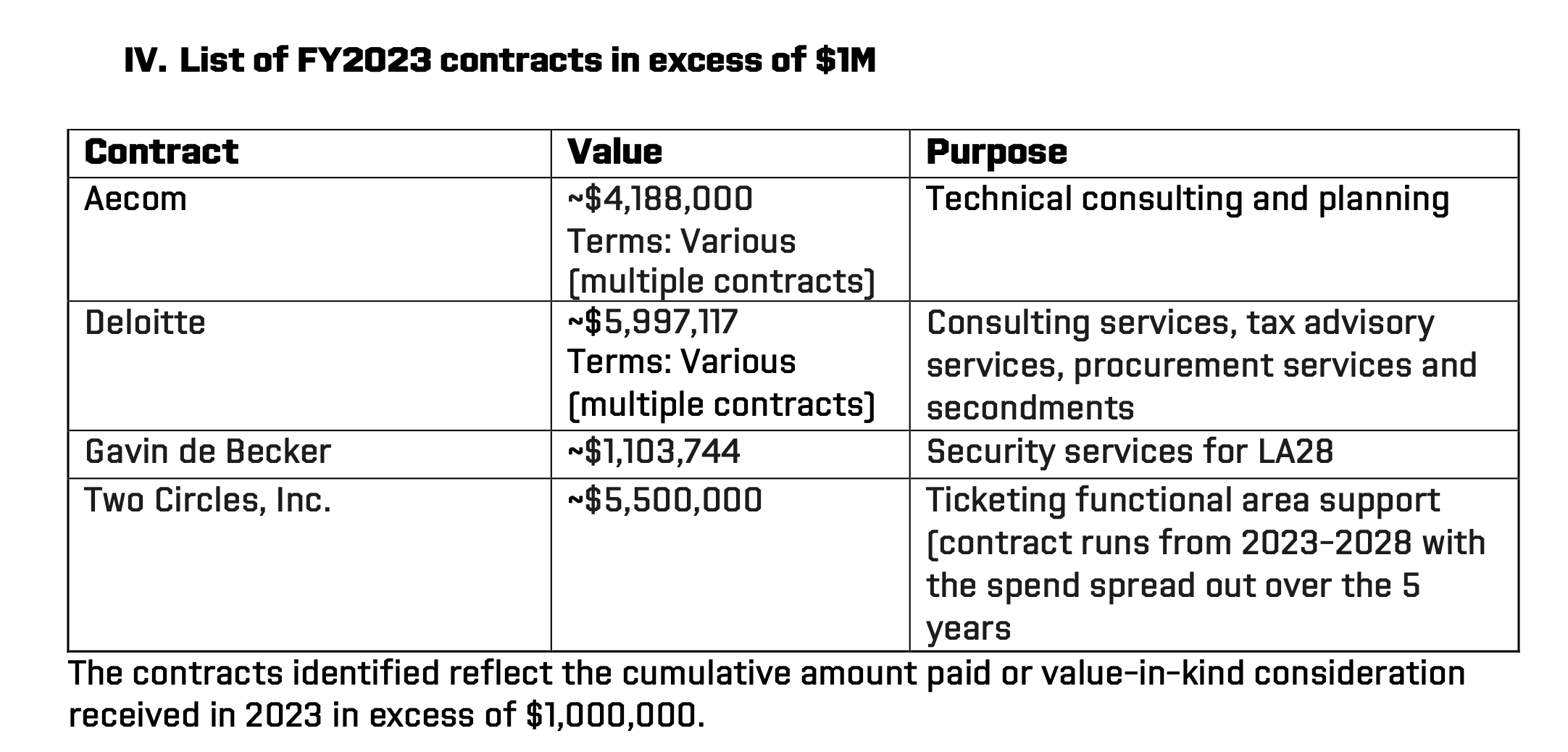
In 2024, I was looking closely at a few of these contracts. As I wrote in August 2024, the high costs of Gavin de Becker's security services had been mentioned as part of the Casey Wasserman "serial cheater" allegations. (Separate from the Ghislaine Maxwell allegations, try to keep up.) Also that year, de Becker — a Joe Rogan regular and author of the book Forbidden Facts: Government Deceit & Suppression About Brain Damage from Childhood Vaccines; glad we're giving him the big bucks! — gave $10 million to a Robert F. Kennedy Jr. super PAC which was then returned, something ethics watchdogs flagged as a highly unusual "bridge loan" arrangement, while also being paid by the campaign as Kennedy's private security detail.
The other contracts I was looking at closely were AECOM and Deloitte, which I found interesting because both companies held multimillion-dollar contracts with LA28 and were named as LA28 sponsors: AECOM is LA28's Official Venue Infrastructure Partner and Deloitte is LA28's Worldwide Technology Integration Partner. But the fine print at the bottom of these disclosures hinted that the money might be flowing both ways: "cumulative amount paid or value-in-kind consideration received."
By the next year, LA28 had already started to hide the names and amounts of contracts over $1 million. Here's the annual report filed August 25, 2025:
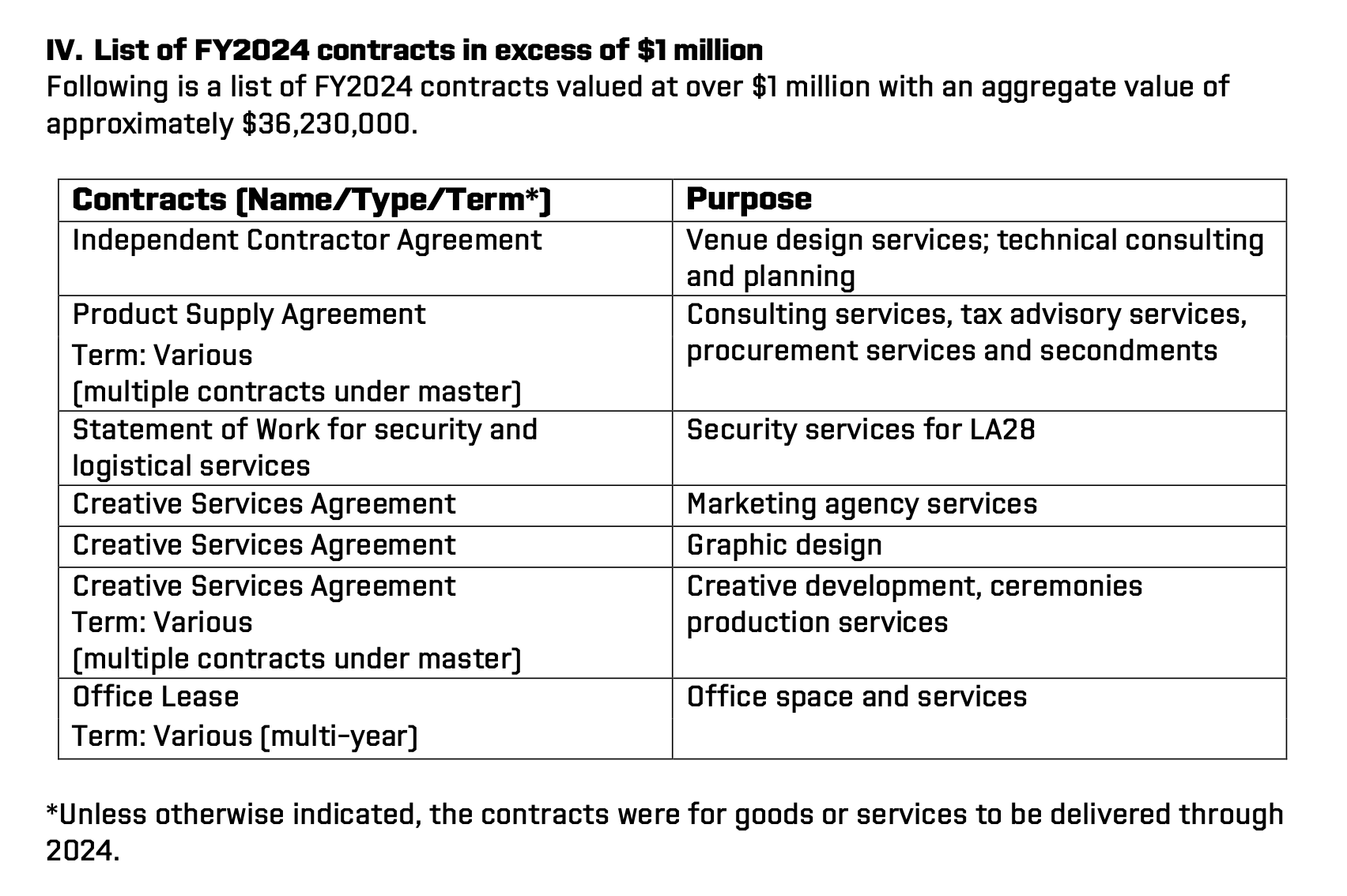
Note that the fine print also changed to "goods or services to be delivered," which is also what it says on the most recent report. No officials brought this up last year, although questions about LA28's opaque accounting practices were raised in SAJE's report on the economic risks of hosting. But officials certainly got into it at this week's ad hoc meeting, the first one since June.
According to Sharon Tso, the city's legislative analyst, LA28 made a presentation in Chief Administration Officer Matt Szabo's office to members of the CAO office, CLA office, and Mayor Karen Bass's office where the contract details for fiscal year 2025 briefly flashed on a screen. But Tso also revealed — to the great surprise of the councilmembers — that the list of $1 million contracts also includes money being given to LA28 by sponsors or partners. In fact, that was LA28's reasoning to city officials for not listing them publicly, Tso said, as that might make it difficult for LA28 to negotiate other deals. If LA28 is supposed to disclose both the $1 million deals coming in and the $1 million deals going out, it was news to all the elected officials in the room. And please also note the dramatic increase in money flowing: $36.2 million in 2024 to $687.2 million in 2025.
Aside from not knowing how much money we're now giving Gavin de Becker to funnel into various MAHA super PACs, this conversation raises new questions about what we're actually getting from these sponsors. When LA28 reports "surpassing $2 billion in sponsorship" does that mean actual money or value-in-kind? And are there secret sponsors and partners beyond the sponsors and partners publicly listed that Wasserman is soliciting on his trips to the White House? Would we know if Palantir offered to pay for our buses?
This lapse further threatens the relationship with the city, said Council President Marqueece Harris-Dawson, who noted that "communication has been very limited" between LA28 and the council since the service agreement was approved. "All of it, taken together, paints a very troubling picture," he said. "In the absence of information, people will make up their own story. And that's already happening, because a tidbit comes out here, and a tidbit comes out there. This needs to be taken seriously, and quickly." 🔥
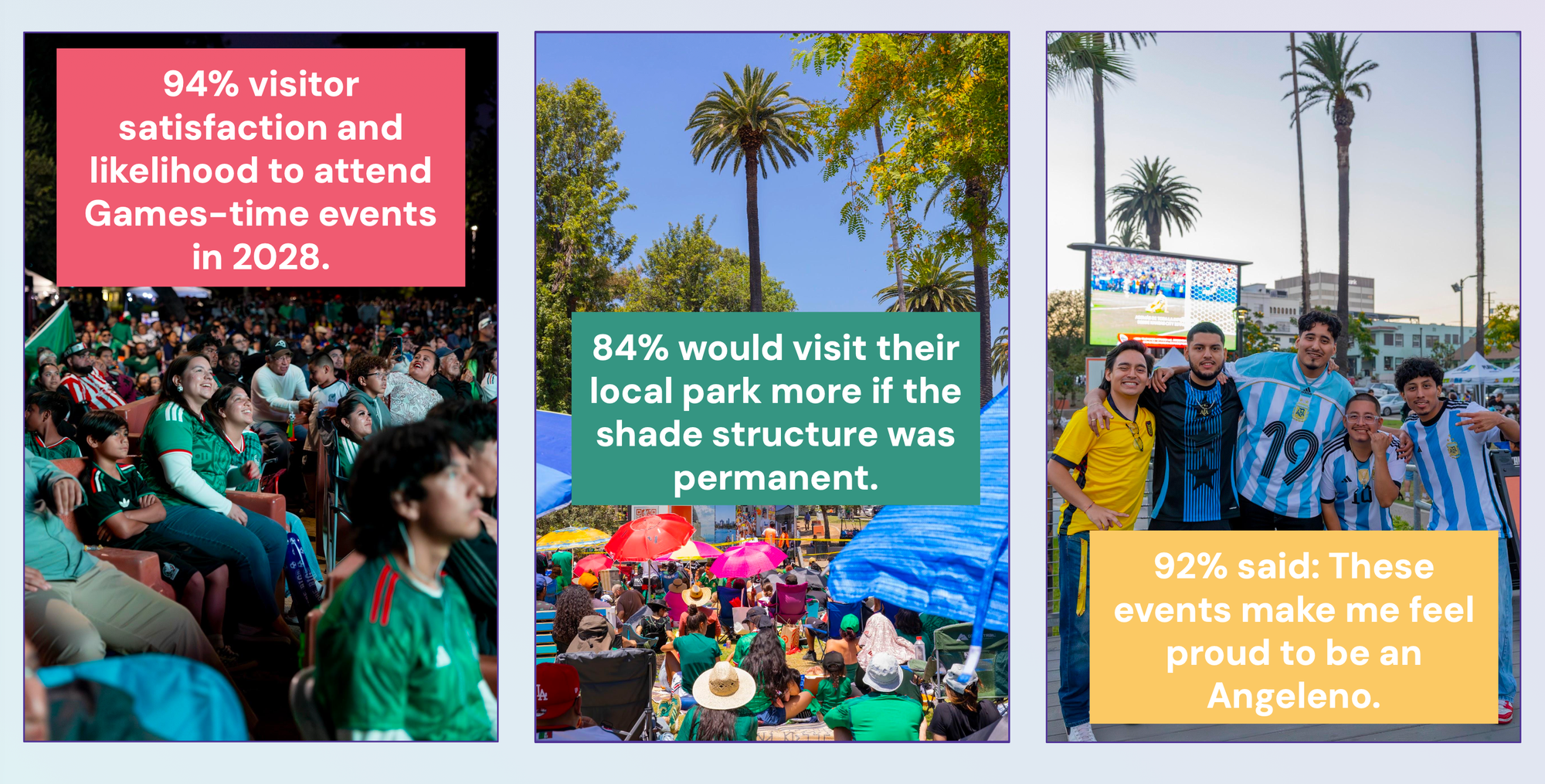
The Office of Major Events delivered its World Cup activation report at the same ad hoc meeting to discuss the Kick It in the Park events. (The website is still up; keep it up!) Executive director Paul Krekorian talked about various legacy investments, like those giant screens which can now be used for all city programs. If you attended an event you know volunteers were diligently collecting survey information, and 84 percent of those queried said they'd come to their local park if it had more shade. Shout out in particular to ShadeLA's "shade library" for the city which now includes deployable shade structures and misters. In fact, heat was #1 in lessons learned: "Investment in shade and cooling is critical to public turnout and safety." Here's the presentation; a more detailed after-action report, and what I hope will include information about costs, is coming soon. 🦋
The potential locations for 2028 activations were announced in a separate report which also includes a very good explanation of all the different types of activations, including LA28's program named Celebrate Two Eight. Many of the recommended locations are the same as Kick It in the Park — Hansen Dam! Watch parties every day in the pool! — and it looks like Hollywood Boulevard will be closed to cars. I was most intrigued by Koreatown's lack of location, as the report notes, simply, "TBD." I was previously tracking Councilmember Heather Hutt's motion to somehow acquire Liberty "Park" but now it sounds like she might want to create a parklet out of a slip lane at 8th and Western. This is good! The report also made me think a bit differently about the two weeks between the Olympics and Paralympics. What do we call this time? Will the activations continue? It's actually 46 days from the opening of the Olympic Games to the close of the Paralympic Games, longer than the 39 days of the World Cup. 🦋
I got a little emotional watching the city's first speed cameras go up outside an East Hollywood elementary school after seven years of tracking this story. These are not Flock cameras; Rep. Laura Friedman, who authored the legislation when she was at the state, reiterated the strict privacy protections she negotiated, similar to our bus lane enforcement. Damian Kevitt of Streets Are for Everyone, who lost his leg due to a speeding driver, equated the rollout to the implementation of seatbelts, noting that San Francisco's speed camera pilot resulted in a 42 percent reduction in traffic deaths. No citations will be issued until 2027 — map and information here; you'll see these signs — but when they go out, they will include stories from local families who have lost loved ones to traffic violence. All revenue goes directly to safety improvements, said Chris Rider, LADOT transportation engineer in charge of Vision Zero, but, ideally, there would be no revenue, he said. "The goal is to put this program out of business because people drive safer." 🦋
 Alissa Walker
 Alissa Walker
"Buses and more buses!" Love this news footage of RTD testing the bus rapid transit routes ahead of 1984, including dispatching 250 buses from Expo Park at once. The best reminder that we did this before and we can absolutely do it again. Also: what happened to all the trees planted around the Coliseum?
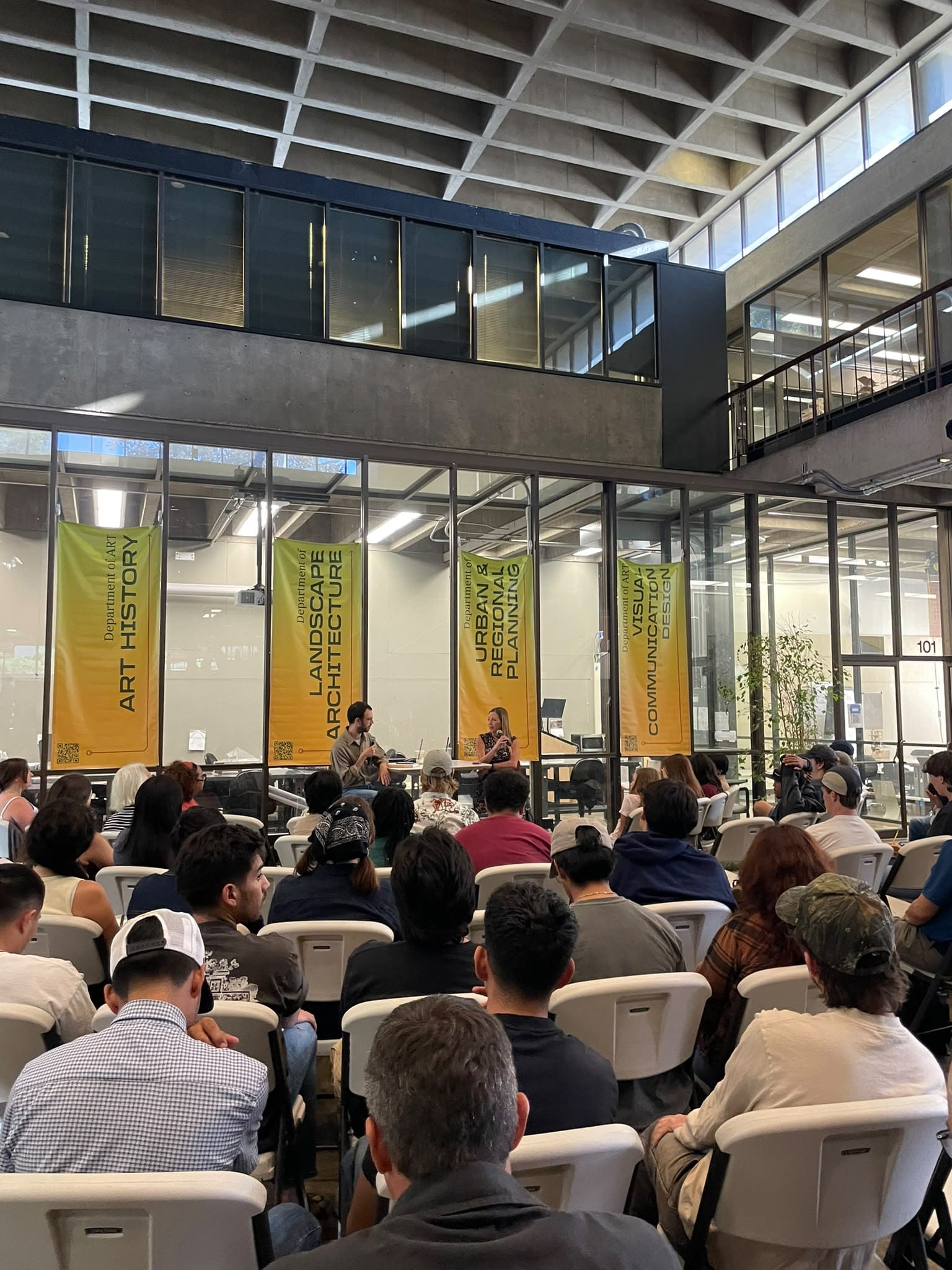
It was my honor to join the ever-shady Sam Bloch and so many incredible landscape design students at Cal Poly Pomona for a conversation on extreme heat on what felt like the only day in the past month that it wasn't at least 90. I'm headed out to Santa Monica right now to appear on a Journalism and Women Symposium panel with The LA Reporter/LA Squawk Box's Liz Chou as "two veteran LA reporters who've gone independent." At least it will be a few degrees cooler — but not much! — out there. See you next week.

Investing $160 million to upgrade where LA's kids play is what LA28 could have been doing for the last ten years


A hurricane canceling a 30,000-person megaevent demonstrates the future that's coming for us

This mayoral endorsement is setting up an even bigger fight about who will stand with workers as they turn the heat up on LA28