
Torched Talks with Keep the Flame Alive's Jill Jaracz
Hear from a Olympic and Paralympic expert on October 19 at noon on Zoom
Hear from a Olympic and Paralympic expert on October 19 at noon on Zoom

It's called open loop, and it's a huge deal

For years, riders of the second-largest (and fastest-growing) transit system in the country have been able to pay that quite affordable $1.75 fare with a phone — or a watch — but we've always needed money loaded onto a TAP card to facilitate the transaction. Now, Metro Los Angeles, like dozens of other public transit systems in California, has moved firmly into the future by allowing passengers to pay fares directly with a debit or credit card. It's called open loop, and it's a huge deal. And Metro quietly soft-launched the new payment system for both bus and rail this week.
We knew open loop payments were coming: this was something that Metro wanted to have in place before millions more megaevent visitors begin to arrive next month. (NEXT MONTH!) But the start date was very nebulous. After I saw Carter Rubin's post appearing to confirm open loop was live, I tried to pay with my debit card myself on the 14 bus headed home from downtown. It seemed to work — I got a very affirming "✅ GO" — but the bus operator said the reader was only in test mode. Then I checked my bank transactions, and lo and behold: "POS DEBIT LA METRO-PAYGO LOS ANGELES CA Pending -$1.75."
Metro's not commenting publicly so the agency can spend some time ensuring everything functions — hence the soft launch — but Torched reviewed an email Metro sent to select partners on Monday confirming open loop was live and encouraging them to test how it worked. (Although if you tried to test it yesterday, it didn't work... because Metro was free systemwide for Bike to Work Day.) All 25 of Metro's partner systems — Big Blue Bus, Long Beach Transit, etc. — also have open loop live, with the exception of LADOT's DASH buses. And yes, using your credit or debit card has all the benefits of your TAP card: free 2-hour transfers, fare-capping — regular-priced riders never pay more than $5 a day and/or $18 within seven days, no matter how many rides you take — and you can even pay for up to 5 riders (!) with the same card, with all the same transfer benefits, although only the first transaction will count towards the fare cap.
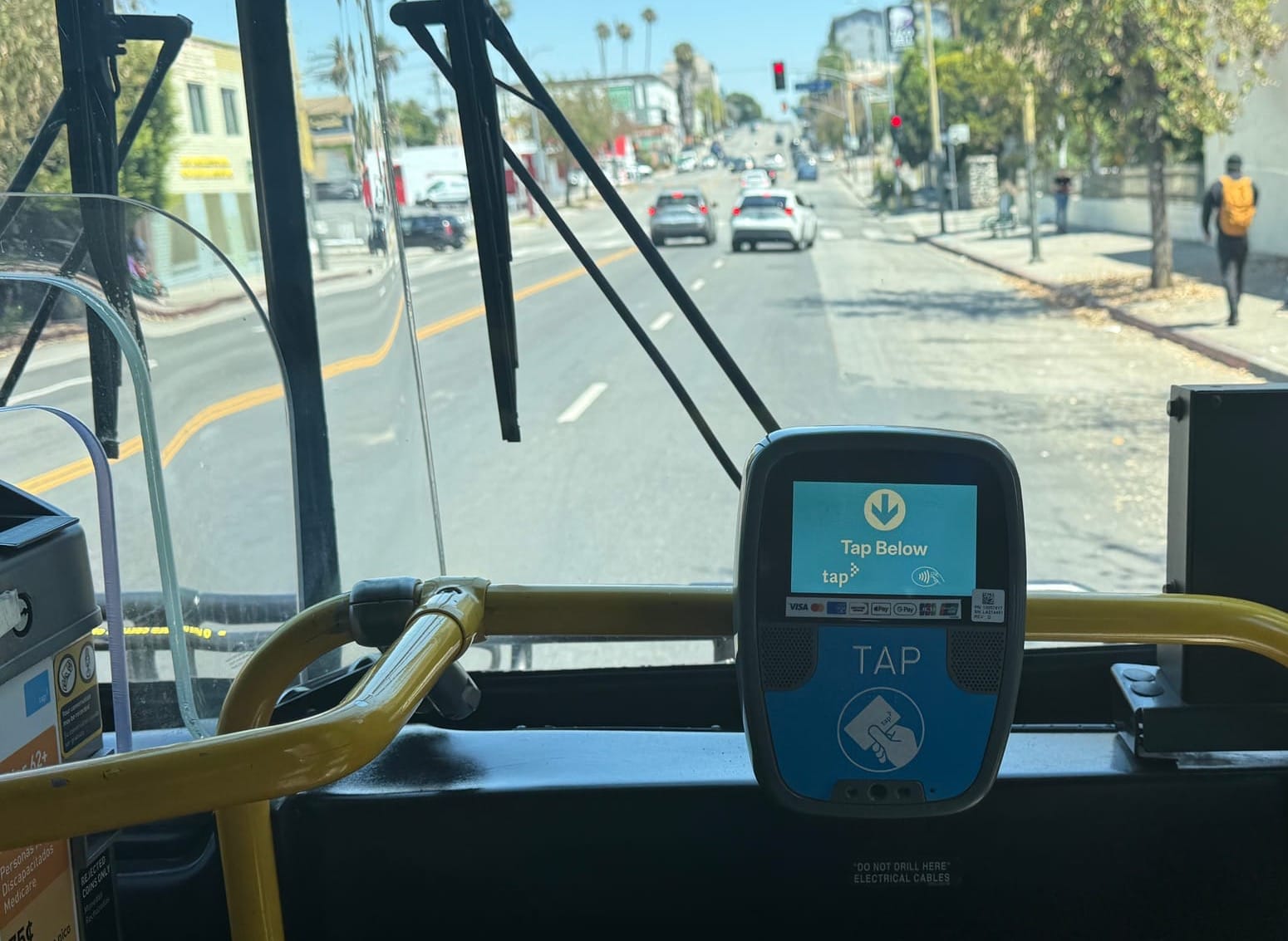
These are the first of a slew of customer experience improvements that are going to hit hard and fast ahead of the World Cup: extensive station activations, more Throne bathrooms, and a new Metro app. I assume the official open loop announcement will also christen the start of Metro's all-door boarding era, since it seems like the readers are now installed universally at both the front and back doors of all the buses I ride.
As we sit on the edge of a brave new transit world, I sure am getting a lot of your questions, and there's no one better to answer them than Hunter Owens, a senior advisor at California's State Transportation Agency (or CalSTA) who has been working on the California Integrated Travel Project (or Cal-ITP) to create a streamlined, modernized, and consistent travel experience across all the state's transit agencies. Here's what he told me about open loop — and why it's about more than just convenience.
Torched: This is so exciting! What's happening here, and why is it such a long time coming for LA?
Hunter Owens: Open loop is the technical term for what LA Metro has launched. You may also hear it referred to as the much-more-easy-to-understand contactless debit/credit payments. What we always like to say here at CalSTA and with Cal-ITP is that we want you to be able to pay for transit like you pay for coffee. When you go to a coffee shop, doesn't matter if it's a Starbucks or your indie coffee pop-up at the corner, you simply tap your credit or debit card or your smartphone wallet — Apple Pay, Google Pay, Samsung Pay — to pay. So that's one of the things we've really been encouraging here through the California Integrated Travel Project, and we're really excited to see LA Metro and the municipal agencies within LA County going live with this in the next few months.
And we should note it's not official yet; there will be some kind of announcement later.
This is in line with best practices, testing to make sure everything works. We do want to see this rollout go as smoothly as possible. So there's always a soft-launch phase.
Because quite a few other agencies have already done this in the state.
Yes, the first agency in the state, actually, with the assistance of CalSTA and Caltrans, was Monterey-Salinas Transit — that went live in 2020. Now, with this launch, a majority of Californians will now be able to use open loop credit/debit payments when they ride the bus or ride the train.
This will be the tipping point, putting our huge ridership on the system. So, how does it work?
It always depends on the agency. But principles and guidance we provide as our agency is to keep a consistent, fair product across the board for both credit/debit transactions and open loop transactions. It's just like your standard TAP card transaction — you're going to pay the exact same amount using an open loop card or a card wallet on your phone. One thing I do want to note for customers is you really have to think about avoiding what we call "card clash." So if you have your debit card in your Apple Wallet, and you give your physical debit card to the transit agency, to these back offices, those look like two different cards, because we actually don't know, oh, it's Alissa Walker, we actually only know the card number, and those are different card numbers.
That's important for people to know: when you put a card into your Apple Wallet, it changes the number and assigns you a totally different number.
Yes, there's no way for the transit agency to know. Hopefully, in the next few years, that will change, but for now stick to always using a debit card, always using an Apple Watch, or always using an iPhone. Just stay consistent, and that way you'll also get the benefits of fare-capping.

So what are the material differences between this and a TAP card, which you can obviously still continue to use?
One of the benefits of open loop transactions is you don't have to preload money. You don't have to say, Hey, I'm going to spend 25 bucks on transit this week, let me go by a ticket vending machine and load that money up. This is especially impactful for low-income customers. You don't want to outlay this amount when you're trying to manage a tight budget, especially in areas where ticket vending machines might be sparser. If you're taking the train every day, obviously, you'll have a touch point with ticket vending machines and you'll be able to load more money in, but it slows you down. But in areas that are more bus-centric, when commutes are always on the bus, you would have to potentially go out of your way to load money onto this special account. This is just simpler.
I'm glad you mentioned the equity concerns. You talked about people not having cash and some agencies are moving towards this model. Here at Metro, there's no immediate plan to phase out cash, but in some ways, like for fare-capping, this could be a much better choice for people.
One thing we're really proud to offer through Cal-ITP is what we call the Benefits tool, so that allows certain participating transit agencies — LA Metro is not one yet — to link various discount statuses to somebody's credit or debit card. If you are a senior and you link the card through your transit agency, instead of charging this card the full $1.75, you're charged 35 cents, which has been super exciting. That technology is now available for any agency statewide.
The other piece of the puzzle is for customers who are underbanked, certainly a big constituency in the LA region, and more broadly across the state. We've been working with the BankOn initiative in places like Monterey-Salinas to make sure that if you don't have a contactless debit or credit card, there are low-fee or no-fee bank accounts you can access that allow you to make electronic payments.
There's also a benefit for tourists or a one-off rider situation, right? This makes it so much easier to tell everyone how to use the system. Actually, most people coming here will already think we have this because they have it at home.
In the Bay Area, within a month of launching at the SFO airport station, 30 percent of taps at SFO airport were credit card/debit card within a month of launch, compared to less than 10 percent systemwide, because again, a person coming into the airport doesn't want to download a special app. It's just the exact same way you're paying for the drink on the plane. It enables a more seamless customer experience, and it's really great for visitors, and especially for global visitors, because what's called the EMV network, European Mastercard Visa, is really global in nature. This allows us to very easily collect fares from visitors from across the globe.
It sounds like this is the future and we're just catching up. Have you used it on Metro yet?
I haven't! I've used it in almost every other part of the state, though. I've used it in Monterey, I've used in the Bay, we've been using it up here in Sacramento. I'm looking forward to Metro's official launch. 🔥


A mission statement, a calendar of events, and an invitation to help shine a light on LA's public spaces, public transit, and public benefits

It's a public bathroom, yes, but it's really a piece of infrastructure that unlocks access to the city