
Downtown's forward motion
The goal is to improve the downtown experience by 2028 by "linking key locations with safer, cleaner, and greener streets, parks, public spaces, and transit hubs"
The goal is to improve the downtown experience by 2028 by "linking key locations with safer, cleaner, and greener streets, parks, public spaces, and transit hubs"

We've got to improve the way we deliver transit information before millions more people get here
Since 2024, the Oscars have provided a new path forward for shouldering the policing costs of major events
LA has limited options to get out of hosting in 2028 — but LA does have options

Even before the news of the past week — is it really only Thursday? — there was an uneasy tension weighing on the city's conscience. Sure, there are a growing number of reasons for Los Angeles to finagle its way out of hosting the economically risky 2028 Olympic and Paralympic Games. But if they didn't happen, for whatever reason, wouldn't this be just as economically risky for the region — if not potentially worse?
This is the question posed in the new report Damned If You Do, Damned If You Don’t: The Risks to LA of Hosting or Withdrawing from the 2028 Olympics. The report was commissioned by Strategic Actions for a Just Economy (SAJE), which has been holding community discussions about local megaevent impacts at its South LA headquarters a few blocks from Expo Park. In part because of their hyperlocal perspective in the shadows of the venues, SAJE has also been member of the NOlympics LA coalition since 2017. "Hosting the Games is already accelerating policing, displacement, inequality, and exploitation in some of our city’s lowest-income communities — and, now, it’s being coordinated hand-in-glove with Donald Trump's Department of Homeland Security," says Chris Tyler, SAJE's communications director. "At this point, these intersecting harms will not be reduced in any meaningful way unless we cancel."
LA has limited options to get out of hosting — but LA does have options, says the report's author Neil deMause, editor of Torched-recommended Field of Schemes. (Torched is cited several times, and I was interviewed for the report.) "The IOC has the hammer of the contract, but it also very much does not want to see the 2028 Olympics caught up in legal wrangling, so there’s at least the potential to try to make some demands in terms of limiting LA’s potential liability." However, says deMause: "LA28 finances are so opaque that we may not know until 2028, if then, who’s really on the hook for what."
Which is why the report outlines steps that LA can take, right now, which seem even more urgent in light of recent developments. And before we rewind to the "how we got here," here are those recommendations:
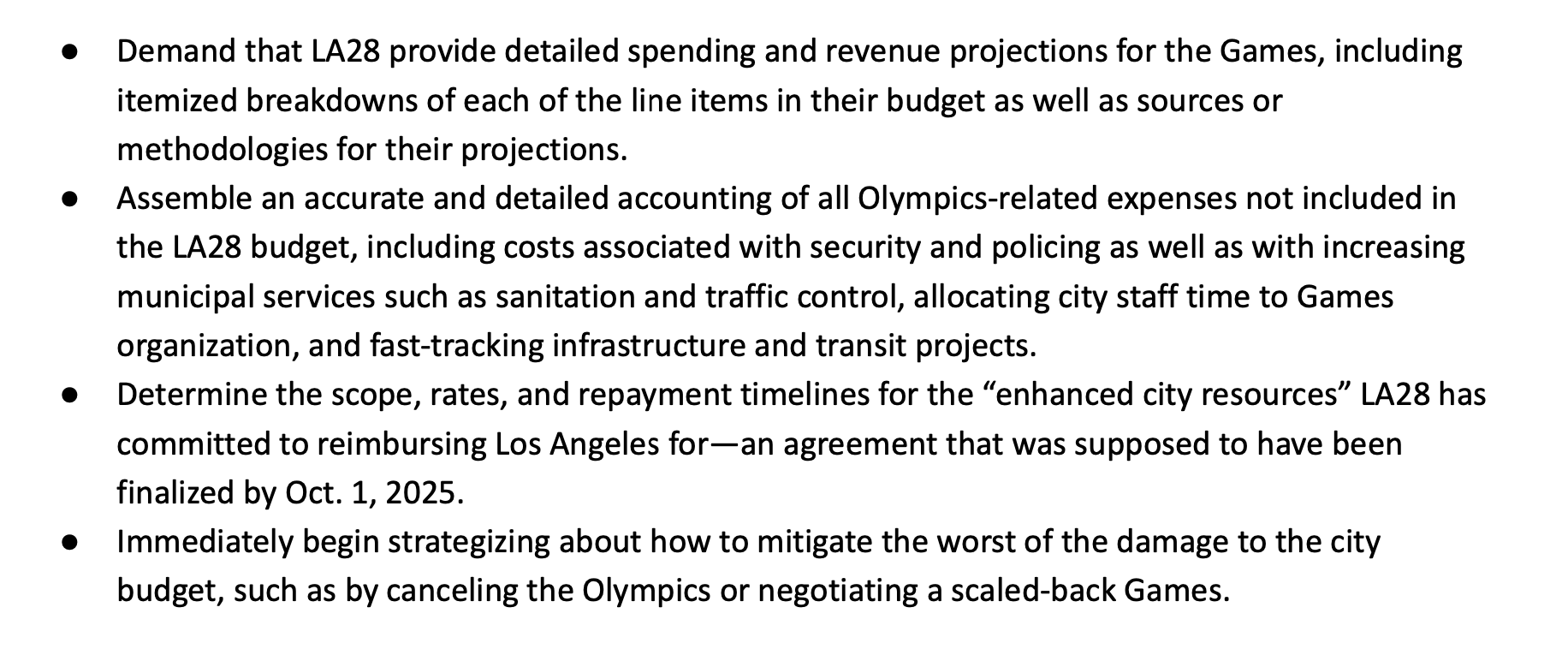
While certain LA officials have started questioning the opacity of LA28's budget, at the heart of LA's conundrum is a decade-old bad deal. Despite having an unprecedented 11 years of lead time when the games were awarded in 2017, the host city contract was approved hastily by LA's council and then-mayor Eric Garcetti.
"LA's leverage was only viable until the city signed the host city contract, and Mayor Garcetti and the council agreed to give that up within a couple of weeks in August 2017 in exchange for a relative pittance in promises from the IOC," says deMause. "For whatever reason, he decided to roll the dice and hope that the 2028 Games would be financially viable just because 1984 was. And nine years later, with two years to go before the opening ceremonies, the dice are still rolling."
And, as the report notes, there are fundamental differences between 1984 and now that need to be understood.
LA's leaders love to tell you how we'll be successful this time because we've done this before: zero-cost, no-build, privately funded, transit-first games. In fact, only one precedent matters, the report notes:
The 1984 Summer Olympics were an exception for one important reason: In the runup to being awarded the Games, Los Angeles city officials had presented a ballot initiative, overwhelmingly approved by voters, amending the city charter to bar the city from covering any losses from that year’s Olympics. Mayor Tom Bradley and the city council even threatened to pull LA’s bid in order to get the IOC to agree to this provision.
Amended the city's charter, you say? The charter amendment was approved 74 to 26 percent — when Angelenos are asked to support games they don't have to pay for, they say yes. Here's a really great story by Mariel Garza, now at Golden State, about Bob Ronka, the Valley councilmember who pushed Bradley to follow through with the plan. Where's today's councilmember pushing for a similar vote on the November ballot?
Have you ever seen the Nike version of "I Love LA" made for the 1984 games? Proof that the '80s were a different moment
This time, not only is LA providing the financial backstop for cost overruns — as our city controller recently reminded us: we pay the first $270 million, then the state pays the next $270 million, then it's back to us for anything additional — the city has also entered into a services agreement with LA28. Some LA leaders are rightfully sounding alarms about this deal, which is still being negotiated as we head into another budget season, despite a due date of October 1, 2025. But it's not hyperbole to say this deal could make or break the city for a generation.
Sharing this sentence which is also bolded and italicized in the report: "In the worst-case scenario, this could result in billions of dollars of future expenses, which could only be covered by raising taxes or slashing city services."
But that's not the only way LA is paying for these games. The report attempts to quantify other sunk costs like city employee staff time spent on megaevents, which might not be internally tracked: "In addition to the city major events officials assigned to work on Olympic preparation, multiple city staffers have been meeting to discuss Olympic planning several times a week since as early as 2021, an untallied off-budget cost that can only be expected to increase." LA officials declined to answer questions about how much staff time is being dedicated to megaevent work, which is alarming for a city that can't deliver basic services.
The scope of the work itself is also unclear: a chart shows estimated costs for venue improvements, for example, both temporary and permanent — yes, permanent, for the "no-build" games — which will require some city coordination, but the status of most projects are "unknown." Torched readers remember that during last year's budget negotiations, LA City Councilmember Katy Yaroslavsky asked for a strategic plan for 2028. Deputy Mayor Matt Hale responded that the city was "headed in the direction of developing that plan." In August, the mayor issued a vision statement that mostly just listed LA28's deliverables. Two years out, we still haven't seen that plan.
There are some innovations in fundraising for 2028. For example, LA28 got permission from the IOC to sell venue naming rights. ("Whether one should count the psychological toll of Angelenos having to see additional ad signage on the sides of public buildings is beyond the scope of this analysis," the report notes. I laughed. Also, good luck adding new signs in this city!) While naming rights are unlikely to provide the windfall that corporate sponsorships and broadcast rights did in 1984, the announcement also illustrates the problem. LA28 doesn't disclose the revenue those naming rights are bringing in. We'll never see how the line-items shift in LA28's laughably vague budget.
While being cagey about direct costs, LA28 and LA continue to promise billions in local economic impact, the final factor to be teased apart in this report. I hesitate to even cite a number as any estimates are outdated and new analysis has not been done by LA28 or by the city that takes our slumping tourism/geopolitical stance into account. (Some current regional estimates are found in a December SCAG analysis.) But my big takeaway from this report is that these numbers are also made up in their own way. I appreciated this metaphor in the report from College of the Holy Cross economic professor Victor Matheson: "Imagine an airplane landing at an airport and everyone gets out and gives each other a million bucks, then gets back on the plane. That's $200 million in economic activity, but it's not any benefit to the local economy." Now imagine if that airport had a functioning people mover...
While there is precedent for sending the games packing — Denver famously rejected the 1976 Winter Games after they were awarded — no Olympics has ever been canceled or relocated this close to the opening ceremonies. The best exit strategy for LA would be an earthquake or another pandemic like the one that rescheduled Tokyo from 2020 to 2021; although, let's be honest, a major labor strike is also on the table. But booting the games still doesn't eliminate the financial risk, including potential IOC litigation, the report notes: "LA is looking at a potential fiscal disaster either way, and the decision on whether to try to cancel or renegotiate the terms of Olympic hosting depends on which you prefer to risk: billions of dollars in losses on hosting the Games, or billions in penalties for not hosting them."
Although it was not in the scope of the report, exactly, I had to ask deMause about another looming risk as leaders across LA call for LA28 chair Casey Wasserman to step down due to his ties with charged and convicted sex traffickers Jeffrey Epstein and Ghislaine Maxwell. In her statement, LA Mayor Karen Bass did not call for Wasserman's resignation, putting the decision on LA28 board members: "Ultimately, any decision on the LA28 leadership must be made by the LA28 board. As you know, they are a separate and independent nonprofit organization." And one that was conveniently stacked with Trump fans in November.
While peer pressure exerted by city officials might compel the board to act, says deMause, he encourages LA's leaders to stay focused. "If Wasserman steps down and is replaced by someone else with the same power to stick LA with billions of dollars in bills, that doesn’t help city taxpayers any," he says. "Wasserman, no matter how distasteful he may be, isn’t the ultimate problem here — it’s LA28 and its contract with LA." 🔥

There is growing concern around the absence of a cohesive human trafficking prevention strategy for LA's megaevent era


Casey Wasserman's own company forced him out — and now LA28 really expects the city to embrace him?

"You want to present this city to the world? I'm going to film the trash and show the world how dirty we are"