
"You can see how the sports events coming up are definitely a risk"
There is growing concern around the absence of a cohesive human trafficking prevention strategy for LA's megaevent era
There is growing concern around the absence of a cohesive human trafficking prevention strategy for LA's megaevent era

Early access for paid subscribers! Everyone else will see these headlines in their inbox at the end of the week
"It will literally be your best selling t-shirt, it will get you so much PR, and if anyone interprets this inappropriately that's a them problem"
There is growing concern around the absence of a cohesive human trafficking prevention strategy for LA's megaevent era

As a human trafficking survivor, Ebony has devoted herself to a singular mission. "To walk along the survivors," she says, "and get them safely to the other side." She's working to establish a survivor-centered nonprofit, advocating for more trauma-informed services, providing education through training sessions, and persuading housing providers to accept trafficking survivors, which many don't. She's also increased her outreach efforts, passing out bags on a recent Valentine's Day filled with condoms, hand warmers, and sanitary wipes. And she's found herself looking ahead to the next few years in Los Angeles with apprehension. "Once you're out of it, you can see how it all goes down," she says. "You can see how the sports events coming up are definitely a risk."
Sex trafficking is only one type of human trafficking that's put advocates in LA on heightened alert. Megaevents bring major upticks in labor trafficking across the construction, hospitality, and fashion industries — imagine the opportunities for exploitation along the entire supply chain for every piece of branded merch that's produced. The other types of events that see a major uptick in human trafficking? Natural disasters. Unfortunately, here in LA, we've been subjected to both, making the region doubly vulnerable. While alarms are being sounded about many potential human rights violations, there is growing concern around the absence of a cohesive human trafficking prevention strategy for LA's megaevent era.
Which is why Ebony and a coalition of survivors and legal advisors flooded public comment at LA's City Hall last month, urging councilmembers and megaevent organizers to make the human rights plans public from both LA28 and the local host committee for the World Cup — which is coming up in less than 100 days.
"LA has a responsibility to prevent human trafficking, especially labor trafficking, around major sporting events," said Rinrada Jongthawornsatit, a legal representative with the Thai Community Development Center. "Transparency is critical, especially in today's climate. Survivors and vulnerable workers need to know what protections are in place."
The issue has become imbued with fresh urgency amidst the calls for LA28 chair Casey Wasserman to step down due to his associations with human traffickers Jeffrey Epstein and Ghislaine Maxwell. In a series of interviews late last month, LA28 CEO Reynold Hoover reiterated his confidence in Wasserman. "We've got a great leadership team here at LA28," he told Reuters. "Just look at the results." But as Torched readers know, LA28 has missed the deadlines for several deliverables, including this one. And multiple LA officials calling for Wasserman to step down have made direct connections between Wasserman's Epstein ties, human trafficking at megaevents, and LA28's missing human rights strategy, which was due December 31, 2025.
"The research makes it clear that major events bring increased risks of labor trafficking," Councilmember Hugo Soto-Martínez, who previously called for Wasserman's resignation and asked LA28 officials about the status of the human rights strategy at January's ad hoc committee meeting. "But if LA28 is doing anything to address those risks, they certainly aren’t telling the public right now."
FIFA also requires a human rights action plan from each of its World Cup hosts — and those strategies are also late. Action plans were originally due last March, then cities were given an extension to August 29, 2025. Six months later, few host cities have made these plans public. In a joint op-ed for Next City, Philadelphia Councilmember Kendra Brooks, New York City Councilmember Tiffany Cabán, and San Francisco Supervisor Jackie Fielder urged host cities to share their plans in order to hold FIFA accountable. "Given FIFA’s history of human rights abuses, our localities are the last credible line of defense to protect communities before, during, and after the games," they wrote. "With just a few months left until the games start, it’s alarming that only a few committees have made their human rights plans public."
This is not just an LA problem. Houston and Dallas only shared their plans last month. San Francisco posted a statement that basically says they're not going to share a plan. LA does have the broad strokes in this 2021 draft document and a follow up Q&A — but nothing finalized and public.
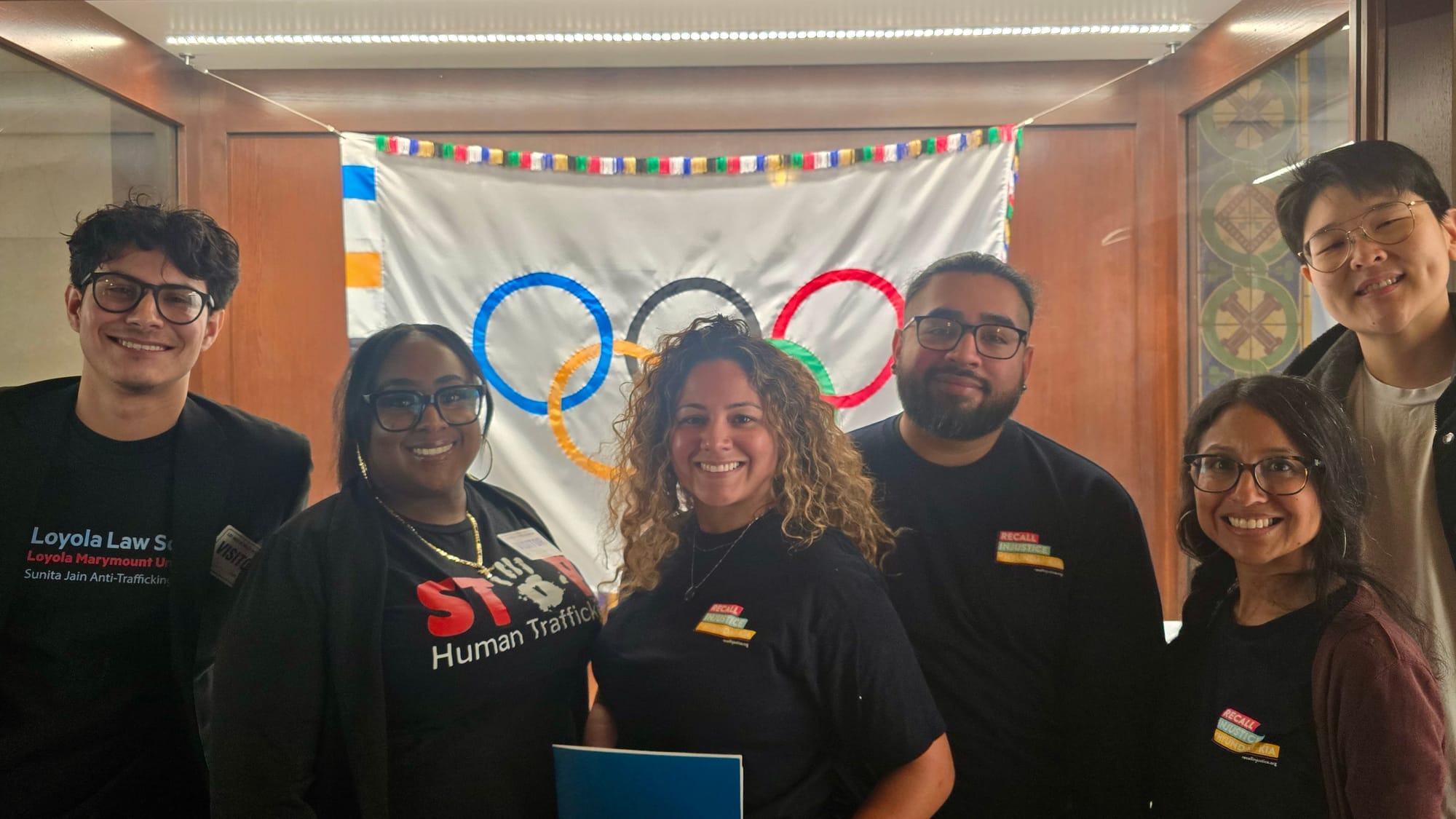
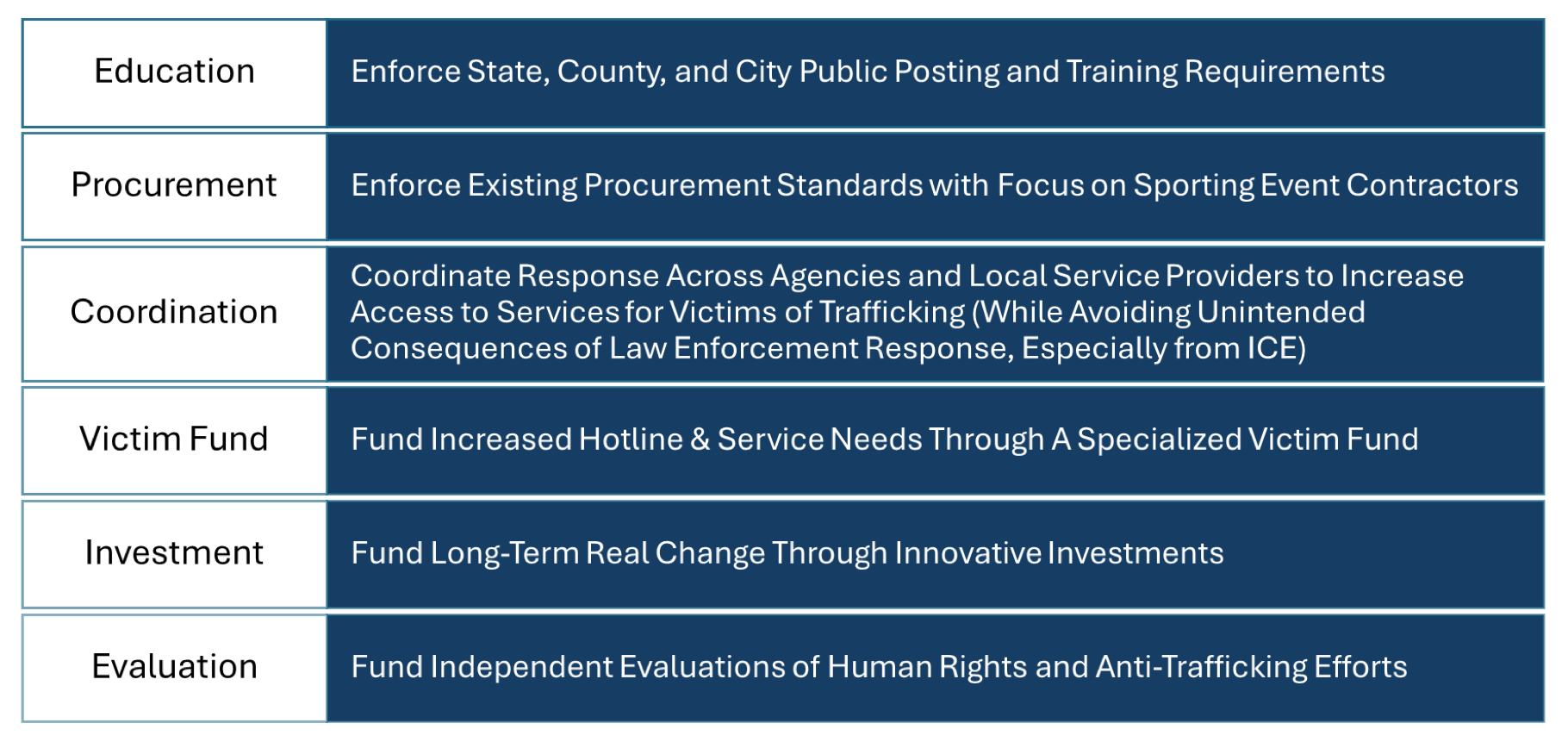
Time is running out as increases in tourism, large gatherings, and economic demand create the conditions for increased trafficking in LA, says Stephanie Richard, who directs the Sunita Jain Anti-Trafficking Initiative at Loyola Law School and has spent 20 years working on human trafficking issues in LA. "We know trafficking is occurring at all times, but it increases in these specific areas at these times, and that provides a strategic window for working on these issues," she says. So when she didn't see officials mobilizing to meet the moment, her organization released its own set recommendations: "Preventing and Addressing Human Trafficking Related to Major Sporting Events in Los Angeles: Recommendations for the 2026 World Cup and 2028 Olympics."
LA is preparing for the 2026 World Cup & 2028 Olympic Games—but we must protect people, not just venues. Big events raise trafficking risk, especially labor trafficking in construction, hospitality & temp work. Prevention must start now. #LA28 #WorldCup2026
— Sunita Jain Anti-Trafficking Initiative (@sunitajainlls.bsky.social) 2026-02-13T23:49:13.153Z
The report has been endorsed by 42 organizations as well as nine state legislators, who are urging LA28 and the LA World Cup host committee to fund solutions that center survivors. "The report makes clear that while billions of dollars will be generated by these events, a dedicated investment of $2.75 to $3.1 million per organizing body — a fraction of one percent of projected revenues — is the minimum necessary to prevent trafficking, protect workers and immigrants, and strengthen the region’s human rights infrastructure," reads the letter from the state legislators.
But where the funding and efforts are directed will make all the difference, says Richard.
"What we know is that a law enforcement approach — what the city and county and nationally, the U.S., has done for the 25 years that there has been increasing awareness of this issue — has failed and failed miserably," says Richard. "When you're only focused on law enforcement, these vulnerable communities, whether they're being sex or labor trafficked, don't come forward and are usually harmed by that kind of action."
Unfortunately, breathless coverage of law enforcement raids, and namely sex trafficking sting operations, dominates megaevent headlines — despite the fact that labor trafficking is far, far more prevalent. As the report notes: "there is no empirical data demonstrating an increase in sex trafficking associated with major sporting events." Just look at this story from last month's Super Bowl about a "sex trafficking crackdown" executed by 67 coordinating law enforcement agencies which are planning to replicate this model in other World Cup host cities this summer. Yet a 2021 report by USC's International Human Rights Clinic found such law enforcement operations to be expensive and ineffective. "Anti-sex trafficking operations identify few victims or traffickers and instead result in the arrest, physical, verbal and sexual abuse of many victims and sex workers — a disproportionate number of whom are LGBTQ people, undocumented immigrants and people of color, particularly Black women and minors,” said IHRC's director Hannah Garry.
"A real approach takes time and services and investment," says Richard. "The best anti-trafficking outreach is individualized, targeted outreach by peer advocates who understand and look like the community, followed by robust wraparound services. You need to be offering really comprehensive, supported services, because that's what a trafficker provides — you have to look better than the trafficker." Richard also recommends a prevalence study to guide a data-driven approach for who is most impacted by trafficking in LA County. "Looking through a public health lens shows we understand the vulnerabilities for trafficking and can invest services there."
Which is why the LA County Board of Supervisors voted last month to establish a human trafficking prevention body housed within the Department of Public Health. But one additional reason supervisors gave for moving anti-trafficking efforts under public health is to protect survivors' information from federal law enforcement agencies conducting immigration raids. And troublingly, as local law enforcement works even more closely with federal agents due to megaevent security agreements, that relationship is becoming even more deeply engrained. Human trafficking training materials used by many law enforcement agencies are developed and disseminated by the Department of Homeland Security. And you probably won't be surprised to hear this, but the DHS-administered tip line to report both human trafficking and "illegal immigration" is THE SAME EXACT NUMBER — a direct call to ICE.
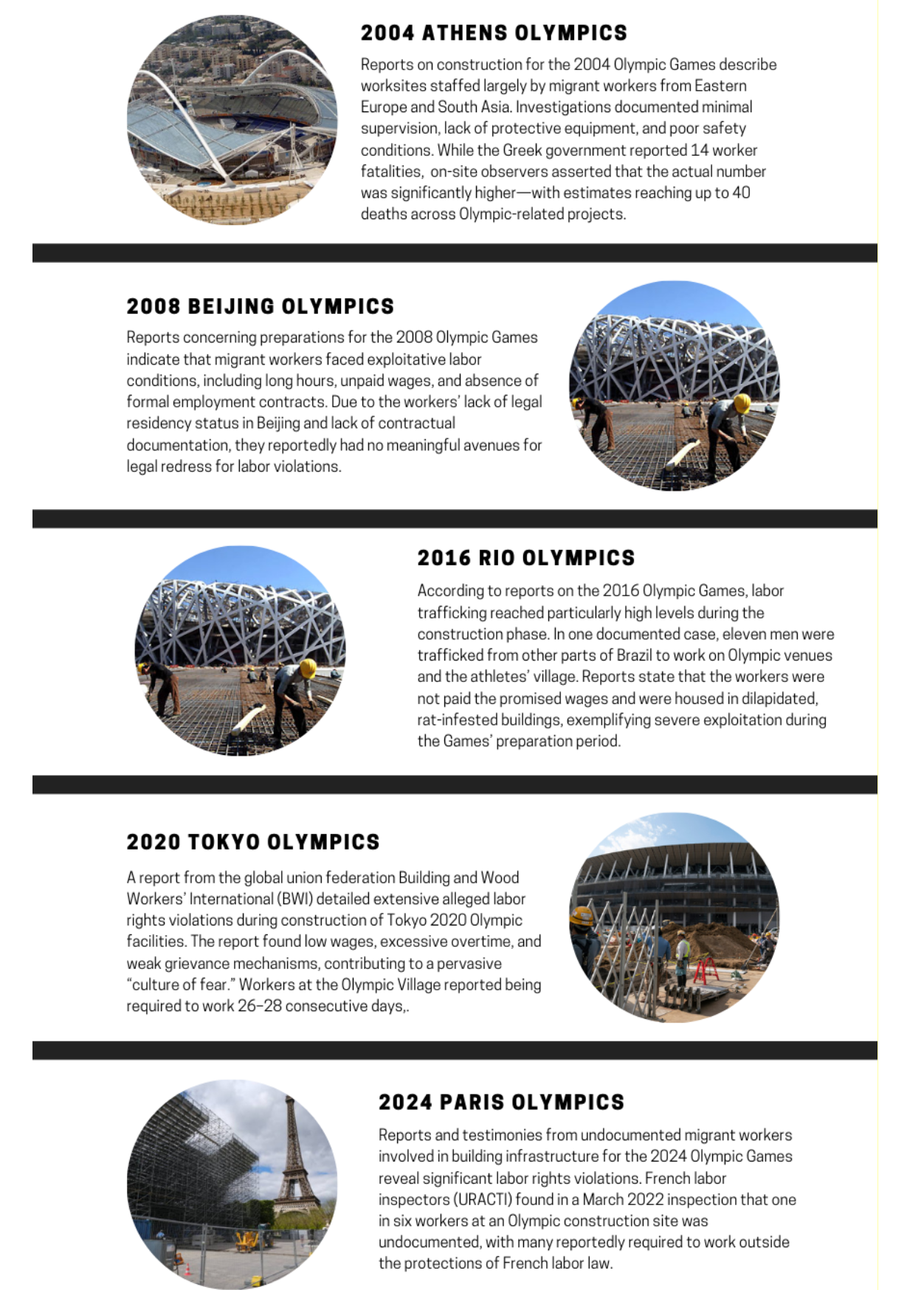
While FIFA's labor trafficking violations have been well-publicized, including potentially thousands of migrant workers who were killed building new stadiums for Qatar's 2022 World Cup, labor trafficking has also plagued IOC hosts. "There have been documented instances of labor trafficking issues at every Olympics and World Cup over the last decade," the report notes. In Paris, an investigation into an Olympic Village site where one in six workers were undocumented migrants brought three construction companies to trial last month. Worker deaths, including one person killed while working on infrastructure for swimming in the Seine, were not included in the official counts, raising concerns about other Olympics-related fatalities that were not recorded. In the rush to build both permanent and temporary structures for our "no-build" Olympics and Paralympics, it's completely plausible that we'll face the same labor trafficking issues here. There's no reason to believe that LA will be different.
What Richard and other advocates want to see here is not just another checked box on a spreadsheet, but for LA to become a global leader in human trafficking prevention. The small investment laid out by these host committees could be more of a legacy improvement — akin to the sustainability grants that LA28 has promised. But even just working within one organization is thinking too small, Richard says. Torched readers will remember that the local World Cup host committee is operated by the Los Angeles Sports & Entertainment Commission, whose sole purpose is bringing even more megaevents to the region. Ideally, LASEC would be working closely with every single organizer to ensure that LA has a public-facing, survivor-centered, anti-trafficking framework going forward, says Richard. "It's worth the process of working this out now, because if we get something really good in place, then this can be something that's required for all their events."
Because as survivors like Ebony keep reiterating, trafficking doesn't wait for a major event. "If this can happen at the Super Bowl, it can be as simple as a big football game going on that brings in the high rollers," she told me. "It can be little things like a gala that's in town." Which is why LA's dedication to the issue requires the same type of regional, cross-jurisdictional cooperation. "One of the struggles I had was finding consistent services that can really help to welcome you back into the real world," Ebony says. "If we can provide those services for trafficking in any type of form, then people can really start over and have a better life." As the self-appointed megaevent capital of the U.S., LA needs this type of social infrastructure in place. These games aren't ending in 2028 — and neither should LA's commitment to survivors. 🔥
 Alissa Walker
 Alissa Walker


Casey Wasserman's own company forced him out — and now LA28 really expects the city to embrace him?

"You want to present this city to the world? I'm going to film the trash and show the world how dirty we are"

LA has limited options to get out of hosting in 2028 — but LA does have options