
Hot Links for this week
Early access for paid subscribers! Everyone else will get the latest news at the end of the week
Early access for paid subscribers! Everyone else will get the latest news at the end of the week

Since 2024, the Oscars have provided a new path forward for shouldering the policing costs of major events
A notoriously anti-bike lane councilmember is using the "car-free" games to stop a fully approved 100 percent affordable housing development
This is the downtown that Frank Gehry wanted. When will LA's leaders give it to us?

Frank Gehry died earlier this month at the age of 96 — a legacy that has proven nearly impossible to summarize in a single remembrance due to his prolific output. Synthesizing a half-century of architecture is never an easy task, but especially when Gehry himself was a true pop culture icon with an actual personality in an industry that takes itself way too seriously. And while I would probably argue his early residential works, including his own Santa Monica home, a stucco-and-plywood chapel enshrouded in chain-link, were actually his best, most stories about his impact have zeroed-in on two similar-looking signature projects and what they did for the cities around them: the Guggenheim museum in Bilbao, Spain, and Los Angeles's own Walt Disney Concert Hall.
It's been funny to read all the stories over the past week about the "Bilbao effect" because despite Gehry's supposed superpowers in transforming a tiny Spanish port city into a global destination, this phenomenon has yet to take hold in his own hometown. Compared to Bilbao's stunning waterfront site, LA's beloved ball of crumpled foil has always felt as if it was discarded on a barren downtown street. This is not a diss of Gehry's design; hey, it's our beloved ball of crumpled foil. But the only way to really appreciate what he's trying to do with Disney Hall is to climb up into its backside, where a set of staircases and elevators lead to a literal secret garden that's a one-acre LA County-managed park. Here, the ice palace vibes feel more like soft folds of mylar, encircling a blossom-shaped fountain made from smashed Delft vases to reveal the building's organic roots. (Yes, Disney Hall is a flower, don't @ me.) Press deeper into the building's metallic crevasses and you'll find a series of hidden catwalks and turrets, rewarding the urban explorer with gasp-inducing vistas in every direction. It's truly one of LA's most triumphant public spaces.
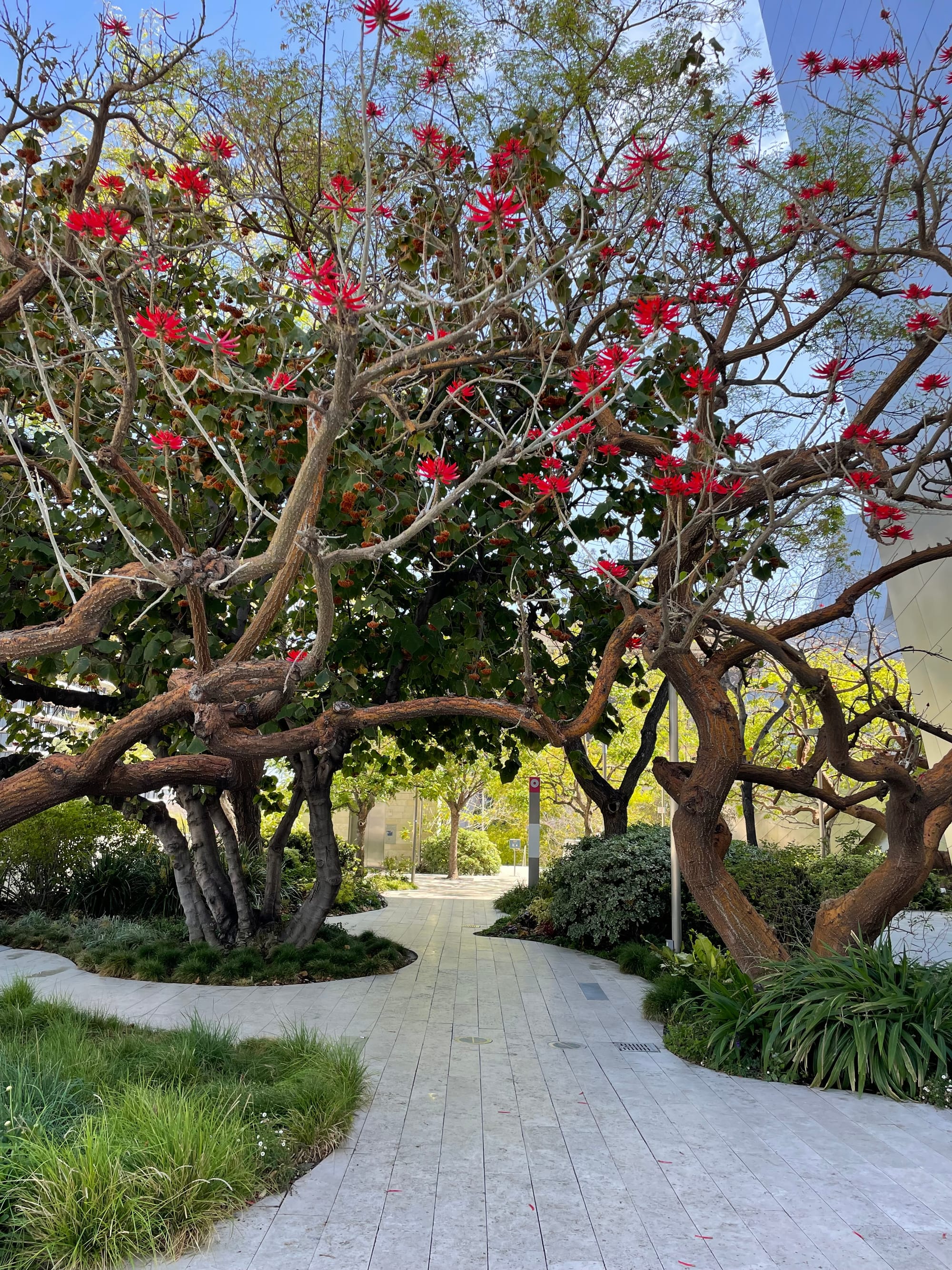
The thing is, unless you've got a ticket to a concert — the design of the interior is important for different reasons, but not for the purposes of this newsletter — you wouldn't even know Disney Hall's party-in-the-back existed; most tourists never make it past the building's name laser-etched into the entrance. For the Grand Avenue audience there are no real signs of life; no trees, no trail of greenery, just the glinting dollops of trash can-melting stainless steel (now buffed to reduce glare).
But a single shiny object deposited on the curb like plop art was never Gehry's intention. Disney Hall was part of a much bigger vision; his Grand Avenue Project was meant to be a one-mile downtown cultural corridor from the Cathedral of Our Lady of the Angels to California Plaza where people would work, live, and play. And to understand how LA's leaders so thoroughly biffed that vision, you have to remember what stood across the street from Disney Hall for a full decade after it was completed. The structure that LA boosters had united around as the symbol of LA's world-class status stared down a rickety, rusted parking structure everyone called the Tinkertoy garage (derogatory). Manifesting Grand Avenue took so long that when Gehry finally revealed the final design for the companion piece to Disney Hall he'd been incubating for a quarter-century, this was the first time many Angelenos learned that Gehry had a more comprehensive plan. And although a few of these fragments have slowly materialized — a residential tower, Conrad hotel, and retail complex opened in 2022; the expansion of the Colburn School, which starts on Grand and wanders down the hill to Olive, is expected to be completed in 2027 — it all feels too little, too late. (Is any of this sounding familiar to Torched readers?)
Grand Avenue remains a collection of the region's best architecture clumped haphazardly along a very bleak, very wide, very dangerous street. Go see for yourself. The majority of the people are standing in line for the Broad museum, crammed uncomfortably onto a narrow sidewalk. There are a few extremely expensive restaurants — although a José Andrés meal is generally worth the cost — and food trucks sometimes clustered nearby with no real places to sit. (The rest of the restaurants are literally underground in California Plaza.) The cavernous movie theater-slash-grocery store space on the Grand's rear end is still empty, as are most of the retail spaces. There are some lovely, leafy moments tucked up into the terraces and plazas. But like Disney Hall's secret garden, many are completely hidden from street level. And the lack of good pedestrian connections make them feel like they’re off-limits to the public when, in fact, they belong to all of us.
And yet Gehry had the solution, way back in 2018. "You close that piece of Grand Avenue, put some chairs out there and you've got something special," he said. "We're not just building buildings, we're building places."
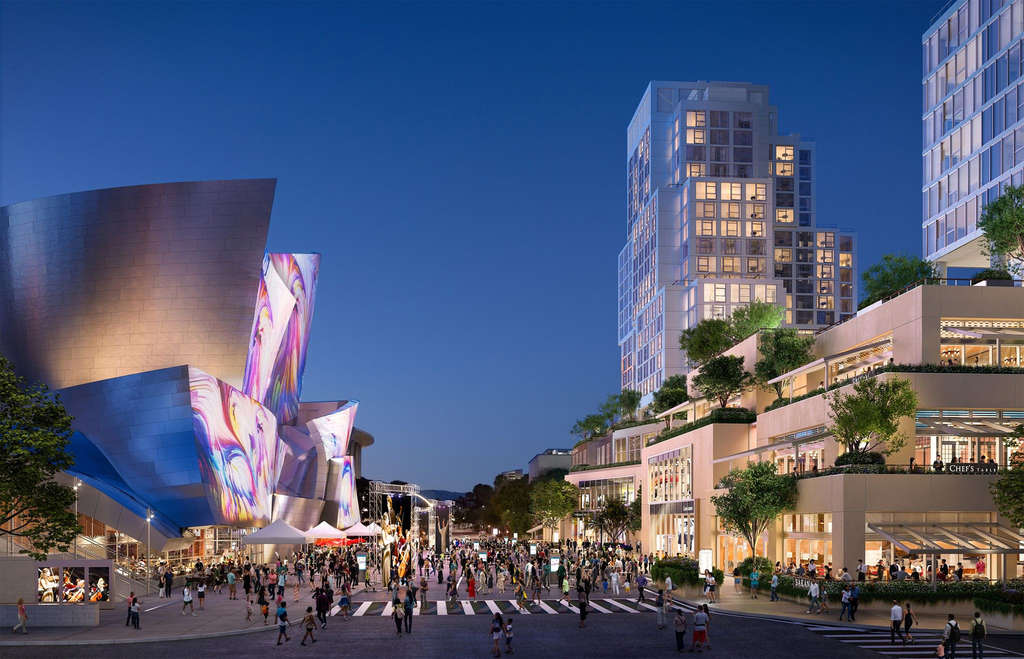
Had the city thrown its weight behind Gehry's vision from the beginning, Grand would be LA's greatest street. The Dodger parade after-party proved he was right. We're talking about a chunk of roadway that's so obsolete there's an entire other roadway stacked beneath it. Multimodal options abound; there are Metro stations on both sides now, plus a century-old funicular to get you back up the hill. This would also be an opportunity to better link Grand Avenue to Grand Park — which was paid for by the developers of The Grand long before the buildings were finished; they're already spiritually aligned — looping those secret gardens and pocket plazas into one continuous greenway. And why stop at the cathedral? Let's keep going over the 101, past LAUSD's VAPA performing arts high school which we all call the water slide (complimentary), and into Chinatown. The Festival Trail has already drawn up visualizations of Grand as a lively cultural market during our upcoming megaevents. It's not too late!
In an interview last year, Gehry said he believed the arts-focused institutions on Grand should steer a downtown emerging from the pandemic. Over the past week, elected officials put out statement after statement praising Gehry's genius, yet they've failed to implement his plan. Some of those officials joined members of the state legislature on a series of walking tours last week to formulate a "downtown recovery" for LA. But as we find ourselves once again shelling out billions on another downtown revitalization project that's not guaranteed to work, our leaders seem to have lost the plot. Cultural anchors are important; great, we have them. LA has no shortage of places to go — now we need places to be. Time to fill in the seams between the starchitecture. Make space for people and put chairs in the street. This is the downtown that Frank Gehry wanted. When will LA's leaders give it to us? 🔥

The spectacle that unfolded along four miles of Melrose on the Sunday before Thanksgiving was a portal into LA's age of activations


If these games are still meant to be "transit-first" — why not announce a transit partner, first?
